
24/7 Customer Support

Free returns

Same-day & Next-day Delivery

Quality Guaranteed

Unlock Your Welcome Offers: FREE Delivery | Up to 80% OFF | Free 30-day JoyPlus trial
Download the APP
Maintaining your oral hygiene routine while travelling across the UK or abroad can be a challenge. A portable water flosser seems like the perfect solution, but the market is filled with devices that promise convenience and deliver frustration. Many buyers find themselves with a gadget that is either too bulky for their luggage, runs out of power halfway through a trip or offers a cleaning experience that is either too weak or uncomfortably harsh.
Before you make a purchase, it is crucial to understand the common pitfalls that lead to buyer's remorse. Here are three frequent issues to watch out for:
To avoid these traps, focus on a few core specifications that determine a cordless water flosser's real-world performance and convenience.
For any rechargeable water flosser, the battery is its heart. Look for models that explicitly state a long battery life, ideally lasting several weeks on a single charge. This ensures you can pack it for a week-long holiday or a business trip without needing to bring the charger.
Equally important is the charging method. A device that uses a standard USB-C connection is far more practical for travel than one requiring a proprietary dock or cable. You can charge it with the same cable and power bank you use for your phone or laptop, reducing clutter and the risk of being left with a useless device.
A genuinely compact water flosser should be designed with travel in mind. This means a slim, lightweight body and, ideally, a detachable or retractable water tank. While a larger tank means fewer refills, a mini water flosser with a capacity of around 200-300ml typically provides enough water for a full cleaning session. The key is finding a balance between a sufficient reservoir and a design that fits easily into a wash bag. A detachable tank also makes the device much easier to clean and dry, preventing mould growth.
Water pressure, measured in Pounds per Square Inch (PSI), dictates the cleaning power. However, more is not always better. High pressure can be uncomfortable for those with sensitive gums or dental work.
A quality portable model should offer multiple cleaning modes. Common options include:
This versatility ensures the device can adapt to your personal comfort and oral health requirements, making it a far more useful tool than a single-setting alternative.
Based on these practical criteria, we have identified models that are well-suited for different user priorities. Instead of focusing on marketing hype, these recommendations are matched to real-world travel scenarios.
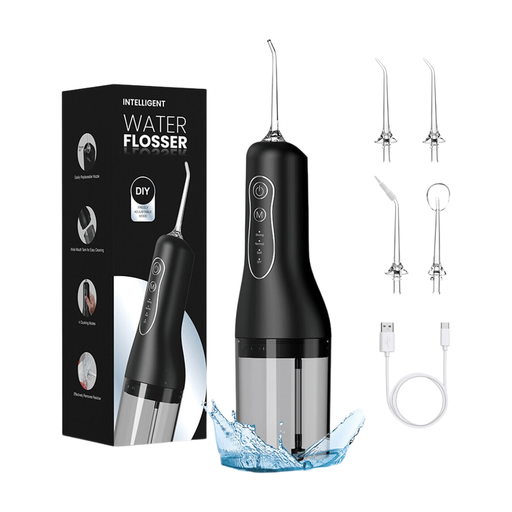
Why This Fits Their Persona: This user prioritises reliability and minimal fuss. They need a device that lasts an entire trip on one charge and can be powered up with the same cable as their other electronics. The sleek black finish is practical and professional for business travel.
It directly counters the battery life pitfall with its impressive 50-day battery life and convenient Type-C charging. Its compact design and 260ml tank offer a great balance, avoiding the 'bulky but portable' trap.
The standout feature is the exceptionally long battery life, making it a true 'pack and forget' device for trips. It also includes multiple nozzles for different cleaning needs.
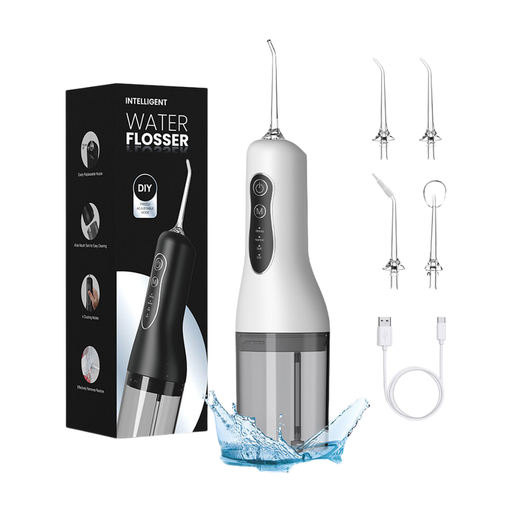
Why This Fits Their Persona: This user may have sensitive gums, dental implants or braces, and requires a gentle yet effective clean. They need a device that offers more control than a standard model. The clean, white design adds a fresh look to their daily routine.
It solves the 'one-size-fits-all' pressure problem with its 4 cleaning modes. The 'Soft' and customisable 'DIY' modes are particularly useful for tailoring the water pressure to avoid discomfort while still achieving a thorough clean.
The customisable 'DIY' mode provides a level of personalisation not often found in portable models. It also comes with a periodontal nozzle, designed for cleaning around braces and below the gumline.
We have compiled a complete, real-time list of products that fully satisfy these strict selection criteria and UK safety regulations.
Charging time varies by model, but many modern devices with USB-C fast charging can reach a full charge in approximately 3 to 4 hours. A long-lasting battery means you will only need to do this once every few weeks, or even less frequently.
Yes, a water flosser can be a very effective tool for cleaning around braces, brackets and wires where traditional floss struggles to reach. It is advisable to use a model with adjustable pressure, starting on a low or 'Soft' setting. Some flossers also come with a specific orthodontic nozzle designed for this purpose.
To maintain hygiene and performance, it is good practice to empty the water tank completely after each use and let it air dry. For a deeper clean, you can wash the tank with warm, soapy water once a week. If you live in a hard water area, descaling the device every 1-3 months with a solution of water and white vinegar can prevent mineral buildup. Always follow the manufacturer's specific cleaning instructions.