
24/7 Customer Support

Free returns

Same-day & Next-day Delivery

Quality Guaranteed

Unlock Your Welcome Offers: FREE Delivery | Up to 80% OFF | Free 30-day JoyPlus trial
Download the APP
A stainless steel wok can become a dependable everyday pan for stir-fries, curries, braises and family-sized meals. However, choosing one based only on its finish or the phrase “non-stick” can lead to disappointing results.
Three common buying traps are worth checking before you pay:
The right choice depends on construction, cooking habits, cleaning preferences and the type of hob in your kitchen.
304 stainless steel is commonly used in food-contact cookware because it offers resistance to corrosion and high temperatures. Check whether “304” refers to the cooking surface, the whole body or only selected components. Product descriptions can also mention combinations such as 304 stainless steel with 201 stainless steel, so read the materials section carefully.
Tri-ply cookware usually refers to three bonded layers. In the supplied product range, the construction may combine stainless steel with an aluminium heat-conducting core. Aluminium spreads heat efficiently, while stainless steel provides the cooking surface and structural body. This type of construction can help reduce localised hot spots, but it does not remove the need to control temperature.
A three-layer body is particularly useful on induction and electric hobs, where even contact with the base matters.
An uncoated stainless steel wok is durable and suitable for high-temperature cooking, but food can stick if the pan is cold, overcrowded or overheated. A practical technique is to preheat the pan, add oil once warm and cook at a controlled temperature.
A honeycomb wok uses a textured surface to reduce direct food-to-metal contact. Some models are described as having a physical barrier rather than a conventional chemical non-stick coating. This may suit shoppers who want a lower-stick surface while retaining compatibility with stainless steel kitchen utensils. Nevertheless, avoid sharp tools that could damage or chip textured areas.
A ceramic non-stick frying pan or wok uses a ceramic coating over a metal body. Ceramic surfaces are generally intended for low to medium heat and benefit from wooden, silicone or nylon utensils. Dishwasher cleaning may be allowed for some models, although hand washing can help preserve the coating.
Do not assume that every “non-stick stainless steel wok” has the same maintenance routine. Confirm the coating type, recommended heat level and cleaning instructions.
For many UK households:
A wok with lid is helpful for braising, simmering and retaining moisture. A glass lid also allows you to monitor food without repeatedly lifting it. Check whether oven use requires the lid or handle to be removed, and never assume that a wok is microwave-safe.
For induction, gas, electric and ceramic hobs, look for clearly stated compatibility. If you use an infrared or halogen hob, check the manufacturer’s instructions before purchase, as compatibility may differ.
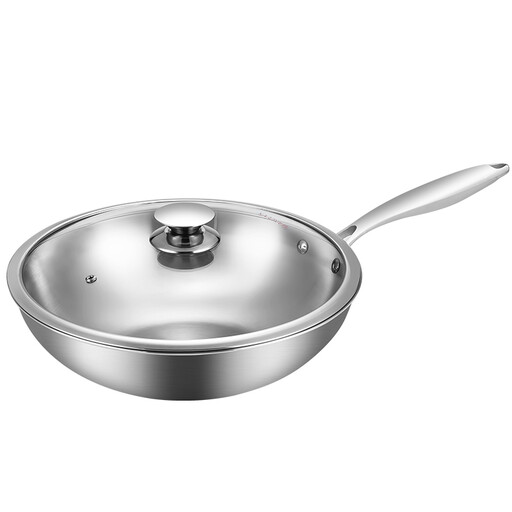
Why This Fits Their Persona: The 28 cm format offers a manageable starting point for everyday stir-fries, sautéing and covered cooking without the footprint of a larger family wok.
The listing identifies the 304 stainless steel body, composite base and stated compatibility with induction, gas, electric and ceramic glass hobs rather than leaving these points unclear.
Uncoated cooking surface, glass lid and dishwasher-stated compatibility provide a straightforward option for routine cooking. Hand washing is still recommended for surface care.
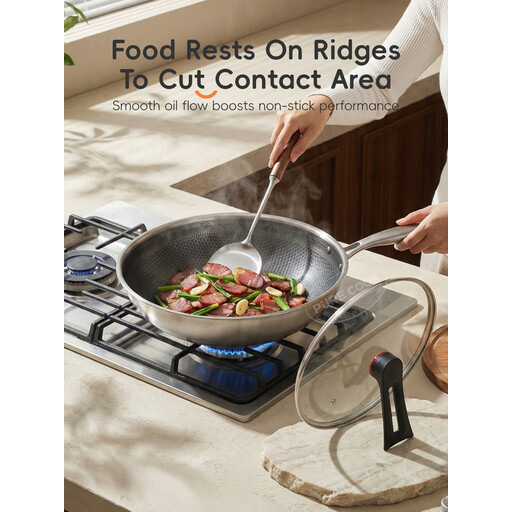
Why This Fits Their Persona: This larger wok is aimed at households cooking generous portions, batch meals or several dishes for family gatherings.
Its listing specifies food-contact grade 304 stainless steel, a three-layer composite structure and compatibility with gas, induction and electric ceramic hobs.
The single-screen honeycomb interior is described as a physical non-stick barrier, while the transparent glass lid supports covered cooking and monitoring.

Why This Fits Their Persona: A 30 cm capacity and covered design suit frequent cooks who move between stir-frying, braising, boiling and other one-pan meals.
The product information states the ceramic coating, honeycomb texture, flat magnetic base and compatibility with induction, gas, electric and ceramic hobs. It also clearly states hand washing is required.
The large cooking area, glass lid and listed support for stainless-steel, wooden and silicone spatulas offer flexibility for regular meal preparation.
A long-handled wok spatula makes it easier to turn food while keeping hands away from hot oil. Stainless steel utensils are appropriate for uncoated cookware, but textured or ceramic-coated surfaces should be treated according to the product instructions.
The PURECOOK 3-piece utensil set includes a slotted spatula, soup ladle and slotted spoon. Its listing gives lengths of 34–38 cm and recommends hand washing, despite conflicting cleaning wording elsewhere in the description. For a simpler single tool, the Maxcook 38 cm 304 stainless steel wok spatula has a hollow handle and rounded edges.
Dry stainless steel cookware after washing, avoid sudden thermal shock and do not leave acidic or salty food sitting in the pan for extended periods.
We have compiled a complete, real-time list of products that fully satisfy these strict selection criteria and UK safety regulations.
Yes, if the product specifically states induction compatibility and has a suitable magnetic base. A flat-bottom design is generally more practical on domestic induction hobs than a traditional rounded wok.
Preheat the wok gradually, add oil once the surface is warm and avoid adding too much food at once. Keep ingredients moving during stir-frying and use moderate heat until you understand how the pan responds.
Cooking cost depends mainly on hob efficiency, heat level, pan size and cooking time. A ceramic-coated pan may allow lower-temperature cooking, but it still needs appropriate care. Avoid prolonged empty heating and sudden temperature changes to help preserve the coating.