Organisers working with limited sockets
If venue sockets are needed for laptops, displays, ticketing or audio equipment, you need a mouse power arrangement that does not depend on charging at your table.


If charging space is the main concern, start with a replaceable-battery Bluetooth mouse, provided your planning device supports it: the mouse needs neither a charging socket nor a USB receiver while in use. A dual-mode mouse adds a receiver option if Bluetooth compatibility is uncertain, but that option occupies a USB port; a rechargeable model makes more sense when you have a dependable way to charge it. For long sessions or work across devices, check hand fit, scrolling controls and switching alongside the power arrangement.
If venue sockets are needed for laptops, displays, ticketing or audio equipment, you need a mouse power arrangement that does not depend on charging at your table.
If you move between a laptop, tablet or another computer while managing rosters and schedules, check compatibility and how the mouse switches connections. Scrolling controls may also matter for wide planning sheets.
If you spend extended periods updating event plans, hand fit and click noise may matter more to you than a compact shape. Check a mouse’s stated hand-size and handedness requirements rather than assuming an ergonomic label establishes personal comfort.
Decide how you will power the mouse during the event, then check its connection against the devices and USB ports you expect to use. Controls and hand fit matter most once those practical requirements are covered.
| Concern | What to check | Who this matters to |
|---|---|---|
| Power away from sockets | Check the battery type and rated life, and plan for a compatible spare or an available charging source. | I do not want to interrupt event setup to charge a mouse while other equipment needs the sockets. Around 38% of consumers put power independence first. |
| Connection flexibility | Confirm host-device Bluetooth compatibility; if considering dual mode, check the receiver and available USB port. | My planning computer may change, but its USB ports could already be occupied. Connection flexibility is the primary need for around 25% of consumers. |
| Devices and planning files | Check supported devices, switching controls and whether horizontal scrolling would help with wide sheets. | I move between devices or work across wide rosters and need the controls to fit that workflow. Around 25% of consumers prioritise device switching and file navigation. |
| Fit and shared-space use | Check dimensions, handedness, stated hand-size fit and click-noise claims. | During a long planning session in a shared room, I care most about how the mouse fits my hand and sounds to others. That is the main concern for around 12% of consumers. |
A wireless connection does not tell you whether the mouse uses a replaceable battery or needs recharging. Either approach needs a workable event-day plan.
Decide whether you can carry a compatible spare battery or rely on a known charging source before choosing a model.
That plan may also mean carrying spare batteries, a charging cable or a power bank.
A Bluetooth-only mouse depends on a compatible host; it cannot fall back to a USB receiver unless the model offers that connection too.
Check your laptop or tablet’s requirements before buying. Microsoft Support, for example, specifies Windows 10 or 11 and Bluetooth 4.0 or later for its Microsoft Bluetooth Mouse; those requirements should not be assumed for other models.
Device-switching controls add little if you use one computer, while hand fit varies by mouse shape and size. A manufacturer’s comfort description cannot establish how a mouse will feel in your hand.
Match the controls to your planning files and check dimensions, handedness and stated fit before choosing a larger or vertical model.
A wireless mouse is an electrical product, so its disposal calls for a suitable electrical-waste route.
For UK disposal, GOV.UK identifies local household waste recycling centres as a route for waste electrical products; check local instructions for the mouse and any removable batteries.
Its cited models cover Bluetooth-only, multi-device and vertical-mouse options for different planning needs.
The cited HP models illustrate a choice between receiver fallback and rechargeable power.
Its Bluetooth Mouse provides a useful example of why the planning computer’s requirements should be checked.
These options cover AA-powered wireless mice for avoiding event-day charging and rechargeable mice for planners who can arrange charging. Choose between them according to your device connections, hand fit and the controls your planning work requires.
 No image available
Consider this AA-powered option if you need to keep venue sockets free and may work across devices in a shared planning space.
The product name specifies 2.4G+BT connectivity and adjustable multi-level DPI. Check compatibility with each device, expected battery life and whether a receiver is included; keep a compatible spare AA if you will rely on it throughout the event.
 No image available
Consider the vertical shape for longer planning sessions only if its size and grip suit your hand; its wireless connection options may also help when choosing how to connect at the venue.
The product name specifies six buttons and an adjustable sensor rated at 1600 DPI. Check host-device compatibility, AA battery requirements and expected runtime before depending on it for a full event day.
 No image available
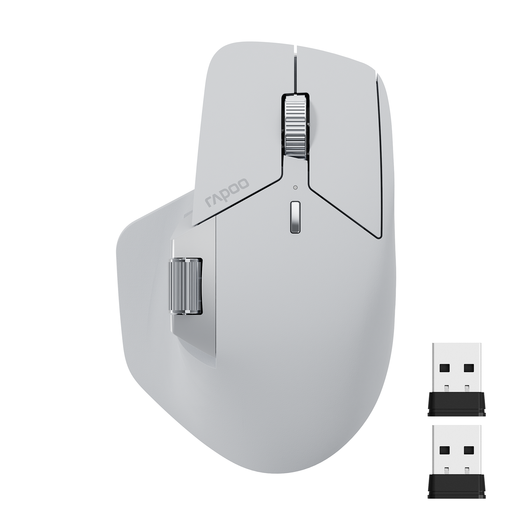
This is an option to examine if you switch between devices or navigate wide planning files and can arrange charging before the event.
Check that its device-switching and side-scroll controls work with your computers, and plan a reliable USB-C charging source for extended use. If Qi charging matters to you, check the separately sold module.
 No image available
Consider this model for longer desk sessions if its shape and detachable wrist rest suit you and you have a dependable charging plan.
Check how its size fits your workspace and event kit, whether its connection works with your device, and that it is charged before you leave.
A replaceable-battery Bluetooth mouse avoids charging during use when your computer supports its Bluetooth connection. Check the exact device’s compatibility and carry a suitable spare battery for an event-day contingency.
Yes, if you check its charge before leaving and have a usable charging source if needed. HP specifies USB-C or Qi charging and up to four months of rated battery life for its HP 695, but that rating does not tell you the charge remaining on an individual mouse.
A receiver is workable if your planning device has a free compatible USB port and you can keep track of it. If that port may be needed for event equipment, consider a dual-mode mouse that can use Bluetooth when your device supports it.
GOV.UK identifies local household waste recycling centres as a route for waste electrical products. Check the centre’s instructions for the mouse and any removable batteries before taking them in.