For tactical role-playing games, a 31.5–32-inch 4K IPS monitor is a useful starting point if readable maps and menus matter most and you also use the screen for desktop work. Consider OLED when dark-scene contrast is the priority and you are prepared to assess panel-care requirements, or Mini LED when HDR features and multi-device connections matter more. Whichever route you choose, check that your device, cable and monitor input support the resolution and refresh mode you intend to use.
Who these monitors suit
Map-and-menu detail seekers
If tactical maps, unit statistics and small interface text drive your choice, a large 4K screen is worth examining. ASUS ROG and LG Electronics UK list 31.5–32-inch IPS models with 3840×2160 resolution; check how your games and desktop look at your preferred text scaling.
Cinematic campaign players
If dark scenes and visual atmosphere matter more to you, compare OLED and Mini LED features rather than relying on an HDR label alone. LG Electronics UK lists a 32-inch 4K OLED model, while BenQ lists a 32-inch Mini LED model with local dimming.
Mixed PC-and-console setup owners
If several devices share your desk, check the inputs and switching features of the exact monitor against each device. Quoted high-refresh modes also depend on a suitable source and connection.
What to check when choosing
31.5–32-inch 4K IPS
Choose when: You want room for detailed maps and text-heavy interfaces alongside everyday desktop use.
Consider: The cited IPS models do not have the Mini LED local-dimming specification or OLED panel technology of the other examples.
32-inch 4K OLED
Choose when: Dark-scene contrast is central to how you want campaigns to look.
Consider: Check the exact model’s panel-care guidance and warranty if static game interfaces or desktop elements will remain on screen for long periods.
32-inch 4K Mini LED
Choose when: You want to assess local dimming and HDR brightness alongside connections for several devices.
Consider: A feature-rich connection setup is useful only if its ports and switching functions fit your equipment.
| Concern |
What to check |
Who this matters to |
| Map and menu detail |
Check native 3840×2160 resolution, screen size and whether your preferred game and desktop text scaling remains comfortable. |
I want to see maps and unit information clearly without making interface text awkward to read. Roughly 50% of consumers put readable tactical detail first. |
| Contrast and HDR |
Compare the exact panel type, HDR specification and any local-dimming features; account for your room lighting. |
Dark campaign scenes matter more to me than a refresh-rate headline. For around 30% of consumers, contrast and visual atmosphere are the main concern. |
| Connections and compatibility |
Match the intended resolution and refresh mode to your device, cable and monitor input; check switching features if you use several sources. |
I need my PC and console to work with the screen without assuming every port supports its maximum mode. Connection flexibility comes first for roughly 20% of consumers. |
Buying pitfalls
-
Choosing by refresh rate while overlooking map readability
A high refresh figure does not by itself address the need to view detailed tactical maps and interface text on a large screen.
Check native resolution, screen size and comfortable UI scaling before deciding how much refresh rate you need for your wider game library.
-
Assuming any cable will deliver the quoted 4K refresh mode
LG Electronics UK says its 32GR93U-B needs a graphics card supporting DisplayPort 1.4 with DSC or HDMI 2.1 to enable 144Hz.
Identify the output on your device, the cable specification and the input you will use on the monitor.
If your existing connection cannot support the intended mode, changing the cable or another part of the signal path may add setup work.
-
Treating every HDR label as the same feature set
The cited IPS, OLED and Mini LED models use different HDR specifications. BenQ lists local-dimming zones and quoted peak HDR brightness for the EX321UX, while LG lists DisplayHDR True Black 400 for the 32GX850A-B.
Compare the exact model’s HDR specification and your viewing conditions instead of using the HDR label alone to choose a panel.
-
Assuming smart and panel-care features work alike across models
Samsung says Gaming Hub and app availability vary by country, and some game-streaming services may require subscriptions. ASUS describes OLED Care Pro as a feature of its XG32UCWG, not every OLED monitor.
Check the exact model’s available services, panel-care settings and support terms before making those features part of your decision.
Relevant brands and models
ASUS ROG
ASUS ROG lists both a 31.5-inch 4K Fast IPS route and a 4K OLED route in its Strix range.
- The XG32UCG specification lists 3840×2160 resolution, up to 160Hz, HDMI 2.1, DisplayPort 1.4 and USB-C.
- ASUS says the XG32UCWG’s OLED Care Pro is intended to reduce burn-in risk; check that model’s care instructions and warranty for your usage.
LG UltraGear
LG Electronics UK lists a 32-inch 4K IPS model and a separate 32-inch 4K OLED model.
- The 32GR93U-B is listed at 144Hz; the OLED 32GX850A-B lists dual UHD 165Hz and FHD 330Hz modes.
- LG says the 32GR93U-B’s 144Hz mode requires suitable DisplayPort 1.4 with DSC or HDMI 2.1 graphics support. Assess OLED-care requirements separately for the OLED model.
BenQ MOBIUZ
The EX321UX is a 32-inch 4K Mini LED option to examine if HDR specifications and desk connectivity influence your choice.
- BenQ lists 1,152 local-dimming zones, 1,000-nit peak HDR brightness, HDMI 2.1, DisplayPort 2.1, USB-C, KVM and eARC.
- Check which of those connections and switching functions your own devices will use rather than choosing them for the game genre alone.
Samsung Odyssey
Samsung UK lists the 32-inch Odyssey G70D with 4K UHD, Fast IPS and 144Hz specifications.
- Its published features include Gaming Hub alongside its display specifications.
- Samsung says Gaming Hub availability is country-dependent, apps vary and some game-streaming services may require subscriptions.
Joybuy product choices
These large-screen choices span 4K OLED and Mini LED models, plus a 34-inch WQHD OLED alternative. If fine tactical-map detail is your priority, compare the WQHD option’s resolution with the 4K models rather than treating screen size alone as equivalent.
 Image unavailable
Dahua 32-inch curved 4K OLED gaming monitor
Consider this if you want a large 4K view for tactical maps and an OLED panel for contrast-focused campaigns.
The product title lists 3840×2160 resolution, 165Hz, HDR400 and USB-C 65W. Check the display mode supported by your device and cable, and review the exact model’s OLED-care guidance and warranty.
View on Joybuy
 Image unavailable
LG UltraGear 32GS95UV-B 32-inch 4K OLED monitor
This is a 4K OLED choice for large maps and contrast-focused play, with dual display modes stated in its title.
The title lists 4K 240Hz and FHD 480Hz modes. Before relying on variant-specific features, confirm that the monitor offered is the titled 32GS95UV-B: the detailed specifications refer to 32GS95UV-W.AEU. Check the intended connection and OLED-care terms too.
View on Joybuy
 Image unavailable
ASUS ProArt Display PA32UCG-K 32-inch 4K Mini LED monitor
Consider this professional-monitor model if a large 4K screen and Mini LED backlighting interest you for gaming as well as other uses.
Its title lists 120Hz and HDMI 2.1. Check the exact input mode and any gaming-specific features you require; also check the quoted HDR brightness under its stated conditions before comparing it with another monitor.
View on Joybuy
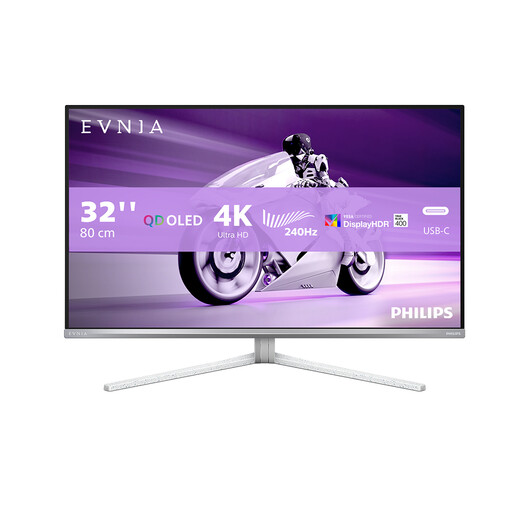 Image unavailable
PHILIPS Evnia 32M2N8900 32-inch UHD OLED gaming monitor
This is a large OLED option for consumers weighing map detail against dark-scene presentation.
The title identifies a 32-inch UHD OLED display and HDR400. Confirm the exact refresh rate and mode before choosing it for high-refresh play, as the product information gives conflicting figures; check OLED-care and warranty terms for this model as well.
View on Joybuy
 Image unavailable
LG UltraGear 34GX900A-B 34-inch WQHD OLED gaming monitor
Consider this if you prefer a wider large-screen OLED format and do not require the 4K resolution emphasised for fine tactical-map and menu detail.
The title lists a 34-inch WQHD display and 240Hz. Check that its format suits your games and desk, and review the exact model’s OLED-care guidance and warranty.
View on Joybuy
Common questions
Is a 32-inch 4K monitor a sensible starting point for tactical RPGs?
Yes, if your main aim is to view detailed maps, tooltips and unit information on a large screen. Check your desk viewing distance, preferred UI scaling and whether your graphics hardware runs your games acceptably at 3840×2160.
Do tactical RPGs require 240Hz or more?
No: a 240Hz-plus mode is not a requirement of the genre. ASUS ROG and LG Electronics UK list 4K IPS examples at up to 160Hz and 144Hz respectively; consider faster modes if other games you play make them important to you.
What do I need to use a monitor’s quoted 4K high-refresh mode?
Your source device, cable and selected monitor input must support the intended mode. For the LG UltraGear 32GR93U-B specifically, LG Electronics UK says enabling 144Hz requires a graphics card supporting DisplayPort 1.4 with DSC or HDMI 2.1.
What should I do if a new monitor is faulty?
Contact the seller and keep the listing, order confirmation and evidence of the fault. For UK consumer goods contracts, the Consumer Rights Act 2015 requires supplied goods to be of satisfactory quality; a manufacturer’s warranty should not be treated as your only route when reporting a fault.


