
24/7 全天候客户支持

免费退货

当日/次日达

品质保障

开启新人专享福利: 全场免邮 | 低至 2 折 | 免费试用 30 天 JoyPlus 会员
下载 Joybuy
Finding the perfect laundry appliance for a modern UK home often feels like a compromise. You want powerful cleaning, but you live in a flat with limited space. You desire a sleek, stylish finish like black, but you're worried about noise in an open-plan living area. An 8kg black washer dryer seems like the ideal solution, but navigating the market is filled with potential pitfalls that can lead to buyer's remorse.
As the Joybuy Product Recommendation Officer, my role is to help you see past the marketing jargon. Before you commit, let's look at the common traps many buyers fall into and how to identify a machine that genuinely meets your needs.
To make a smart purchase, focus on the technical details that directly impact performance, convenience and long-term value.
The spin speed, measured in revolutions per minute (RPM), determines how much water is wrung out of your clothes after the wash cycle. A 1400 spin washer dryer is an excellent benchmark. A higher spin speed means clothes go into the drying phase with less moisture, which significantly reduces drying time and energy consumption. While 1600 RPM models exist, 1400 RPM offers a great balance of water extraction and fabric care.
In many UK homes, space is at a premium. A standard freestanding washer dryer is typically 60cm wide and 85cm high, but the depth can vary. A standard depth is around 60cm, but a slim depth washer dryer can be as narrow as 52cm. This small difference can be critical for fitting the appliance under a kitchen worktop or in a tight utility cupboard. Always measure your space carefully, leaving an extra 7-10cm at the back for pipes and ventilation.
The motor is the heart of your machine. Traditional brushed motors can be noisy and wear out over time. Modern appliances often use a BLDC (Brushless Direct Current) Inverter Motor. These motors have fewer moving parts, making them substantially quieter, more energy-efficient and more durable. This is the key technology behind a truly quiet washer dryer and is often backed by a longer warranty, giving you peace of mind.
Instead of a generic list, we've matched specific models to the people they're designed for.
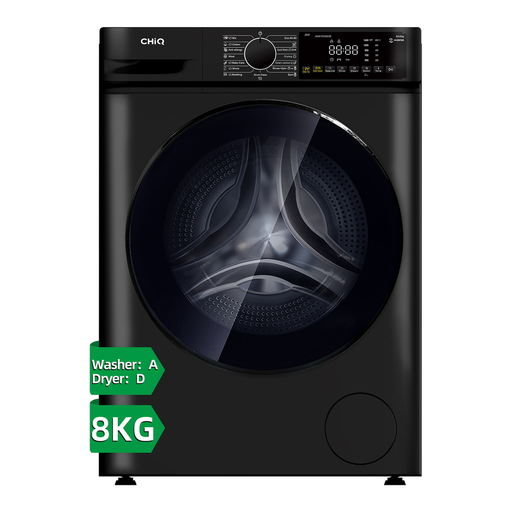
Why This Fits Their Persona: This model is a perfect space-saving laundry appliance for modern living. Its premium black finish complements contemporary kitchens, while the slim depth of approximately 520mm allows it to fit into tight spaces where standard appliances cannot. The 8kg wash 5kg dry combo is ideal for singles or couples.
It directly addresses the noise pitfall with its quiet BLDC Inverter Motor. It is transparent about the 8kg/5kg capacity split and provides both the 'A' wash and 'D' wash-and-dry energy ratings upfront.
The combination of a quiet, long-lasting inverter motor (with a 12-year warranty) and a genuine slim-depth design makes this a standout choice for compact, style-focused homes.
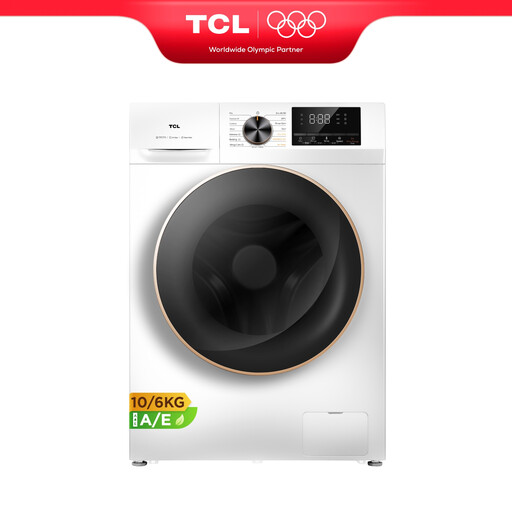
Why This Fits Their Persona: For families or households with larger laundry loads, the step up to a 10kg wash and 6kg dry capacity is a game-changer. It handles more clothes, towels or even a double duvet in a single cycle, saving valuable time. Features like a 60-minute wash & dry cycle are perfect for getting outfits ready in a hurry.
This model is clear about its larger 10kg/6kg capacity, preventing users from misjudging load sizes. The A/E energy ratings are stated, allowing for an informed decision based on the need for higher capacity versus running costs.
The primary benefit is the larger drum capacity, which reduces the number of laundry days per week. The inclusion of a Steam Wash function also helps to reduce creases and refresh garments quickly.
We have compiled a complete, real-time list of products that fully satisfy these strict selection criteria and UK safety regulations.
A 5kg dry capacity is more generous than it sounds. It's roughly equivalent to 25 T-shirts, a pair of adult jeans and a few tops or one double duvet. The key is to avoid packing the drum tightly. For effective drying, the load should only fill the drum about halfway, allowing warm air to circulate freely.
This depends on how you use them. The wash cycle on a modern machine (like the A-rated CHiQ washer dryer) is very energy efficient. The drying cycle, which uses heat, is what consumes more power, leading to the lower 'D' or 'E' rating for the combined cycle. However, using the high 1400 spin speed to remove excess water first will make the drying process shorter and more economical. For many, the convenience and space-saving benefits outweigh the slightly higher running cost compared to two separate appliances.
No, a freestanding washer dryer is designed for easy installation. It requires the same three connections as a standard washing machine: a cold water inlet, a waste pipe for drainage and a standard 13-amp electrical socket. You do not need any special plumbing or external venting. Just ensure you have enough clearance behind the unit for the hoses to connect without being kinked.