
24/7 Customer Support

Free returns

Same-day & Next-day Delivery

Quality Guaranteed

Unlock Your Welcome Offers: FREE Delivery | Up to 80% OFF | Free 30-day JoyPlus trial
Download the APP
Buying adjustable kids inline skates can be a sensible way to manage growing feet, but a low price or colourful design does not tell you whether a pair will remain comfortable, stable and usable. Parents often discover that the wrong size, weak fastening system or unsuitable wheels makes skating frustrating after only a few outings.
This guide explains what to check before buying children’s inline skates, how to avoid common product traps and which options may suit different young skaters.
Children’s footwear sizes vary between manufacturers, while inline skate shells may use their own measurements. Buying solely by a child’s usual school-shoe size can result in pressure at the toes, heel movement or an unstable fit.
Check the stated skate length in millimetres and measure the child’s foot from heel to longest toe. Adjustable skates should be set to a snug length, rather than extended fully simply to gain more growing room.
Most growing-feet skates use a sliding toe section with several marked positions, commonly A–B–C–D. However, the actual range differs between models. For example, some small sizes cover approximately 146–170 mm, while larger versions may extend beyond 249–273 mm.
Always check the specific size variant. A product family may include XS, S, M and L, but each listing can have a different starting and ending length.
Terms such as PU, PVC and ABEC describe materials or component specifications, not a guarantee that a child will stop safely or remain balanced. Wheels still need to match the user’s ability and skating surface, while brakes require practice.
For young beginners, a rear brake, secure closure and protective equipment are more immediately useful than simply choosing the highest-sounding specification.
A practical pair of adjustable roller skates for children should offer:
The adjustment should be easy for an adult to operate, but the finished setting must not move during use. After tightening, check that the heel stays in place when the child bends their knees.
Many recreational skates use either PVC wheels with 608Z bearings or 82A PU wheels with ABEC-5 carbon steel bearings.
PVC wheels can be suitable for occasional recreational use on smooth, paved paths. PU wheels are commonly selected by buyers looking for a more responsive rolling feel. Neither option removes the need to inspect the skating surface: wet paving, loose gravel and uneven tarmac can affect control.
Bearing grades should not be interpreted as a complete performance score. Keep wheels and bearings dry after use, particularly in the UK’s changeable weather, and check that mounting hardware remains tight.
A plastic chassis can provide a practical recreational construction, while an aluminium frame may appeal to older children or more frequent users seeking a rigid support structure. The choice should also consider weight, fit and the child’s confidence level.
Look for kids inline skates with brakes, especially for beginners. A brake pad is only one part of safe stopping; children should learn controlled braking under adult supervision.
For children starting out, a set containing a helmet, knee pads, elbow pads and wrist guards can be more convenient than buying each item separately. Check the product information for applicable UKCA or CE marking, sizing guidance and care instructions. Protective equipment should fit securely and be replaced after significant impact where the manufacturer advises it.
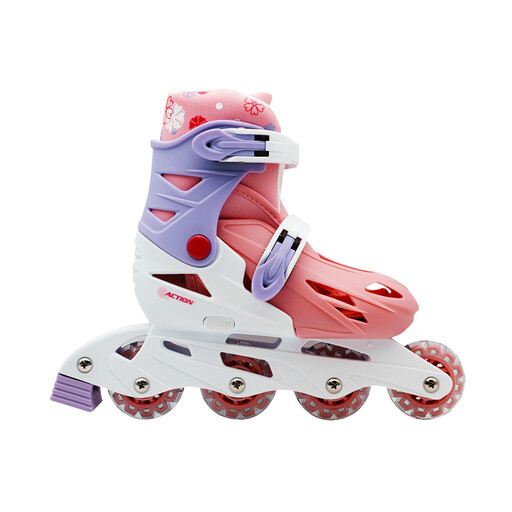
Why This Fits Their Persona: A straightforward option for a young beginner who needs a compact adjustable range for occasional park or paved-path skating.
The listing states a four-position push-button adjustment, a wear-resistant brake pad and a 153–177 mm skate length for the XS variant.
Soft boot, plastic chassis, safe-lock buckle and Velcro straps; supplied as a pair with brakes.
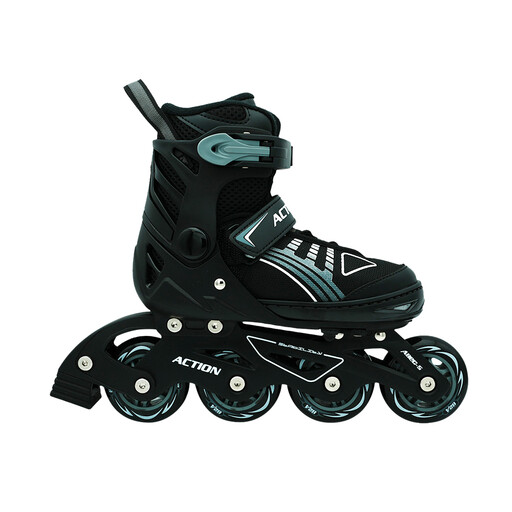
Why This Fits Their Persona: Suits families seeking a more supportive construction for regular recreational sessions and children progressing beyond first attempts.
Its specification identifies an aluminium alloy chassis, four-way adjustment and a rear wear-resistant brake pad.
Eight 82A PU wheels, ABEC-5 carbon steel bearings, soft boot, Velcro strap and safe-lock buckle.
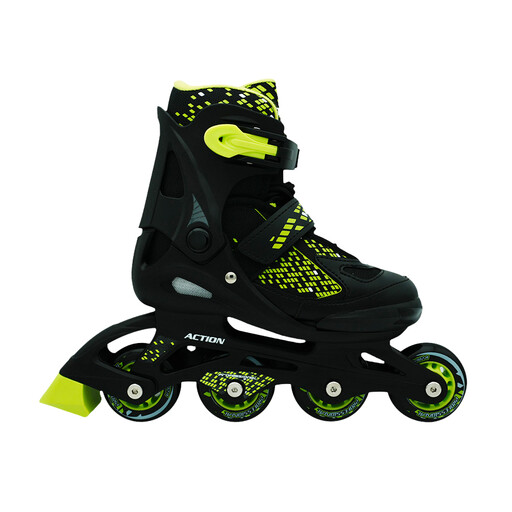
Why This Fits Their Persona: A suitable direction for older children who skate more frequently and want PU wheels with a defined bearing specification.
The model lists a four-way adjustment system, lasting toe-cap, secure buckle and included brake rather than relying only on appearance-led features.
Eight 82A PU wheels and ABEC-5 carbon steel bearings; available in the M range at 209–234 mm.
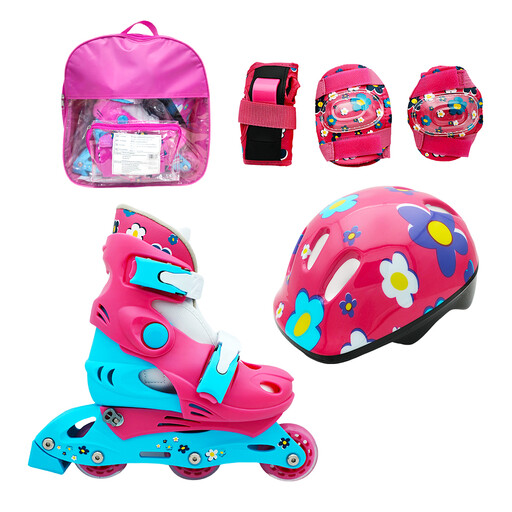
Why This Fits Their Persona: Convenient for a first skating gift when the family needs skates and protective equipment in one portable package.
The package includes a helmet, knee, elbow and wrist protectors, plus a carry bag, while the skates include a buckle, straps and brake.
Four-way adjustment and an XS length of 146–170 mm; PVC wheels and 608Z bearings are specified for recreational use.
We have compiled a complete, real-time list of products that fully satisfy these strict selection criteria and UK safety regulations.
Before the first session:
After skating, wipe the boot and protective equipment with a damp cloth. Dry wheels, bearings and any metal frame components after damp-weather use. Store the equipment fully dry and inspect the brake pad, straps, wheels and frame fasteners regularly.
They can be suitable for recreational beginners when correctly fitted and used with a brake and full protective equipment. Children should practise balance, turning and stopping gradually on smooth, level ground with adult supervision.
Lifespan depends on growth, frequency of use, surface conditions and maintenance. The adjustable range may extend the usable fit across more than one footwear size, but wheels, brakes and bearings can wear sooner with frequent skating. Check these components rather than relying only on the adjustment feature.