
24/7 Customer Support

Free returns

Same-day & Next-day Delivery

Quality Guaranteed

Unlock Your Welcome Offers: FREE Delivery | Up to 80% OFF | Free 30-day JoyPlus trial
Download the APP
Buying kids adjustable inline skates can be more complicated than choosing a colour and size. Children grow quickly, and a pair that appears suitable on a product page may become uncomfortable, unstable or difficult to use after only a few outings.
Parents and gift-buyers should look beyond promotional phrases such as “smooth rolling” or “durable design”. The important questions are whether the skate adjusts correctly, supports the ankle, includes a brake and suits the child’s actual foot length. This guide explains the main pitfalls and compares suitable options for different skating needs.
Children’s footwear sizes are not fully consistent between brands or models. Inline skate listings may use ranges such as 26–29, 30–33 or 37–40, but these figures should not replace measuring the child’s foot.
A better approach is to measure from the heel to the longest toe in millimetres, then compare this measurement with the product’s stated skate length. Avoid buying a much larger pair “to allow room to grow”. Excess movement inside the boot can make balancing and stopping more difficult.
Most adjustable rollerblades for kids use a button or lever system that moves the toe section through four marked positions. However, the available range varies between models. A skate listed as XS may cover 146–170 mm, while another XS option may cover 161–185 mm.
Check the complete range rather than relying on the label. The adjustment mechanism should also lock securely after each change. A loose buckle, open strap or incorrectly positioned toe section can affect comfort and control.
Terms such as PU wheels, ABEC-5 bearings and aluminium frames describe useful components, but they do not automatically make a skate suitable for every child.
For a young beginner who will skate occasionally on smooth pavements, a durable plastic chassis and PVC wheels may be adequate. A child who skates more frequently may prefer 82A PU wheels, ABEC-5 carbon steel bearings and an aluminium chassis. The right choice depends on surface, frequency and experience rather than the longest feature list.
Look for a four-way adjustable system with clear A–B–C–D settings. Measure both feet and use the longer measurement when selecting a starting position. The skate should hold the heel firmly without compressing the toes.
Soft boot inline skates can feel comfortable for recreational sessions, particularly when paired with a padded liner. A high-impact shell or toe cap can add structure around the foot. A safe-lock buckle combined with Velcro straps is useful for creating a secure fit, although every closure must be fastened correctly before use.
PU wheels are commonly selected for smoother rolling and responsive movement on suitable paved surfaces. The products featured here use eight 82A PU wheels, a specification suited to recreational skating and regular outdoor use. PVC wheels, used on some complete sets, offer a different material construction and are also intended for recreational use.
ABEC-5 inline skates use bearings marked ABEC-5. The rating describes manufacturing tolerance, not a guarantee of speed, comfort or safety. Clean and dry wheels and bearings after use, especially in damp UK weather. Never skate through puddles, as moisture can contribute to corrosion and reduced rolling performance.
A plastic chassis can provide a practical balance for beginners, while aluminium frame inline skates may appeal to users seeking a more supportive frame for frequent skating. Confirm that a wear-resistant brake pad is included and check which foot it is fitted to before the first session.
Kids inline skates with brakes should always be used with a helmet and wrist, elbow and knee protection. One complete set includes a helmet and protectors, while most standalone junior inline skates require safety equipment to be purchased separately. The listed animal-themed helmet is marked EN1078 tested and CE certified; check the supplied product information and fit carefully before use.
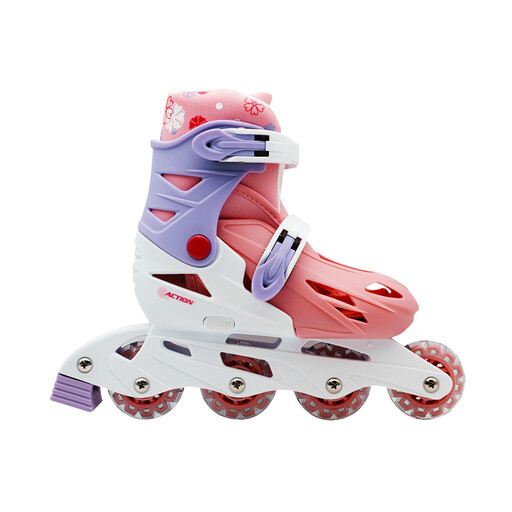
Why This Fits Their Persona: A practical starting option for a child trying inline skating on smooth paths, driveways or local paved areas. Its stated 27–30 range covers 153–177 mm.
The four-way push-button adjustment is more precise than choosing an oversized fixed skate, while the safe-lock buckle and Velcro straps help secure the fit.
Soft boot, high-impact plastic toe cap, eight 82A PU wheels, ABEC-5 carbon steel bearings and an included brake pad.
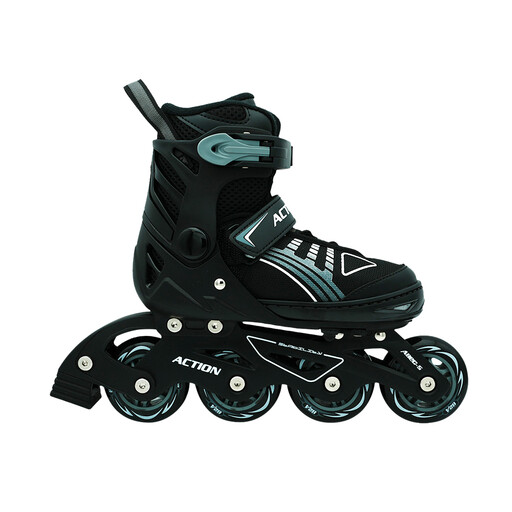
Why This Fits Their Persona: Suitable for families prioritising frame support and a more structured setup for frequent recreational sessions.
The specification clearly identifies the chassis as sturdy aluminium alloy, rather than leaving the frame material unclear.
Four-way adjustment, eight 82A PU wheels, ABEC-5 carbon steel bearings, soft boot, Velcro straps and a reinforced toe cap.
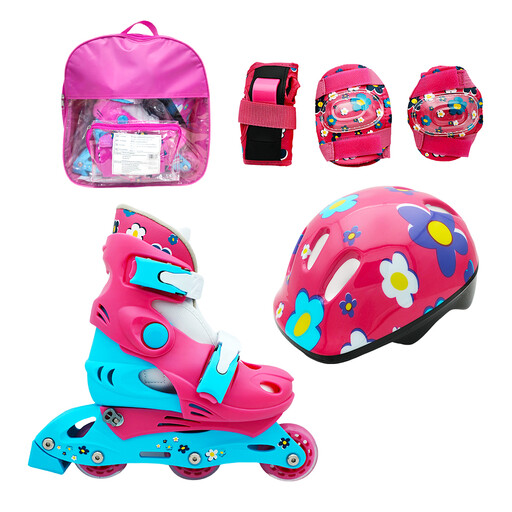
Why This Fits Their Persona: A convenient kids skating gift for families that want skates and protective equipment together rather than sourcing separate items.
The listing specifies that the set includes a helmet, knee pads, elbow pads, wrist guards and a carry bag, avoiding uncertainty about what is supplied.
Four-way adjustable skates, PVC wheels, 608Z bearings, wear-resistant brakes and a portable carry bag.
We have compiled a complete, real-time list of products that fully satisfy these strict selection criteria and UK safety regulations.
They can be suitable for beginners when the fit is secure and the child learns on a smooth, obstacle-free surface. Choose a model with an included brake, practise stopping at low speed and provide adult supervision. Protective equipment should be worn for every session.
The usable period depends on growth, frequency of use, surface condition and maintenance. Four-way adjustment can extend the fit across multiple foot lengths, but it does not prevent wear to wheels, brake pads, straps or bearings. Inspect the hardware regularly and replace equipment after significant damage.
A complete set is convenient for a first-time skater because it includes the main protective items in one purchase. If buying standalone children’s inline skates, check that the helmet fits correctly and that knee, elbow and wrist protection are purchased separately where necessary. Always follow the product’s safety instructions and supervise inexperienced skaters.