
24/7 Customer Support

Free returns

Same-day & Next-day Delivery

Quality Guaranteed

Unlock Your Welcome Offers: FREE Delivery | Up to 80% OFF | Free 30-day JoyPlus trial
Download the APP
As skateparks fill with the sounds of wheels on ramps, more children and teenagers are drawn to the exciting world of freestyle scootering. For parents, however, choosing the right stunt scooter can feel overwhelming. You want something that is safe, durable enough for tricks and offers good value for money.
This guide is designed to cut through the clutter. As the Joybuy Product Recommendation Officer, my role is to provide clear, practical advice to help you select a suitable trick scooter that will support your child's skills as they progress from their first bunny hop to more advanced manoeuvres.
Before looking at specific models, understanding a few key components will help you make a more informed decision. A good beginner stunt scooter needs to balance performance with safety.
Unlike commuter scooters, a freestyle scooter has a fixed, non-folding frame for maximum strength. The deck should be wide enough for comfortable foot placement but not so large that it becomes cumbersome. Look for materials like T-6061 aircraft-grade aluminium, which provides an excellent combination of low weight and high durability. The handlebars should be at a comfortable height for the rider—generally around their waist level—and are often made from strong materials like 4130 chromoly steel for added resilience during landings. A solid fork and a reliable clamp system (like a triple clamp) are crucial for holding the scooter together under pressure.
Stunt scooter wheels are typically made from a hard-wearing polyurethane core with a metal alloy hub. Common sizes are 100mm and 110mm. Smaller wheels offer quick acceleration, while larger wheels provide a faster, smoother ride, making them a popular choice for a skatepark scooter. The smoothness of the ride is also determined by the bearings. Bearings are rated with an ABEC score; a higher number, such as ABEC-9, indicates a more precise and efficient bearing, resulting in a faster and smoother glide.
The overall weight of the scooter is an important factor. A lighter scooter can be easier for a younger rider to handle, manoeuvre and practise tricks with. However, a slightly heavier build can offer more stability. Always check the manufacturer's recommended age and weight limits to ensure the scooter is appropriate for your child. This is especially important when choosing a stunt scooter for kids versus a scooter for teens.
Based on their construction, components and suitability for beginner to intermediate riders, here are our recommendations.
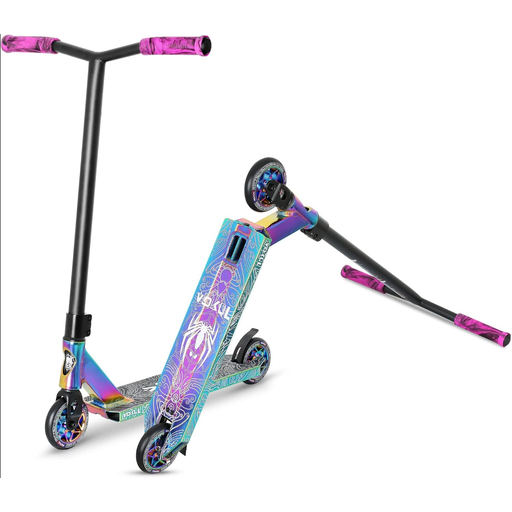
View VOKUL K1 Pro Trick Scooter (Neo)
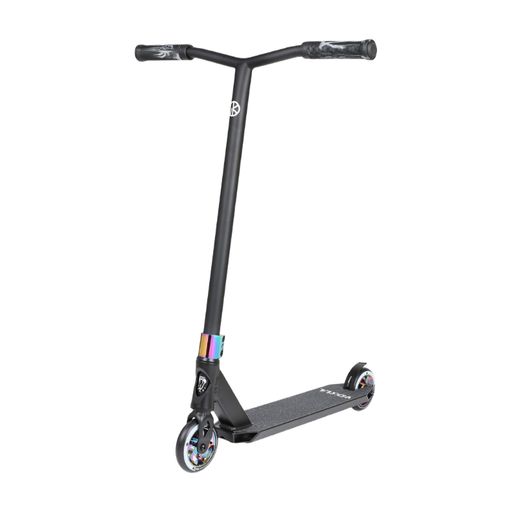
View VOKUL K1 Pro Trick Scooter (Neo-Black)
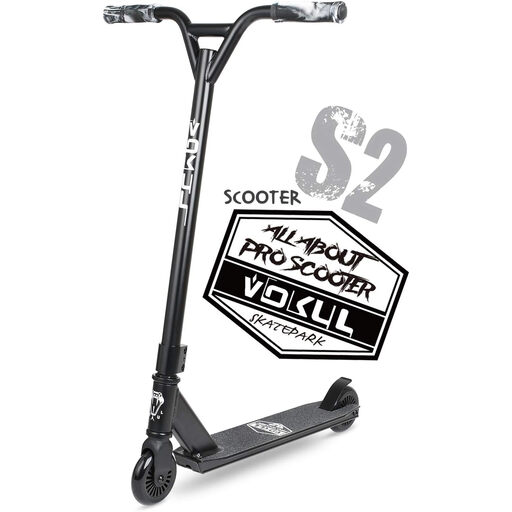
View VOKUL S2 Complete Pro Scooter
While these scooters are excellent starting points, every rider has unique preferences. If you're searching for different styles or other great gift ideas, why not explore our curated collection for teen girls? You might find the perfect fit there.
What is the difference between a stunt scooter and a regular scooter? A stunt scooter is purpose-built for tricks. It features a one-piece, non-folding frame and handlebars for superior strength. The materials used, such as reinforced aluminium decks and steel bars, are chosen to withstand the impacts of jumps and landings. Regular kick scooters are designed for transport, are often foldable for portability and are not built to handle the stresses of a skatepark.
What size stunt scooter should I get for my child? A good rule of thumb is to have the rider stand on the scooter's deck. The top of the handlebars should sit somewhere between their hip and waist. This height allows for good control without forcing them to hunch over or reach up uncomfortably. Always check the manufacturer's specifications for handlebar height and recommended rider age.
Is a heavier or lighter stunt scooter better? This depends on the rider. A lighter scooter, like the VOKUL S2, is often easier for smaller, younger riders to control, lift and manoeuvre for tricks like tailwhips. A slightly heavier scooter can feel more stable at high speeds and during landings, which some intermediate riders prefer. The choice is a trade-off between agility and stability.