
24/7 Customer Support

Free returns

Same-day & Next-day Delivery

Quality Guaranteed

Unlock Your Welcome Offers: FREE Delivery | Up to 80% OFF | Free 30-day JoyPlus trial
Download the APP
A flat battery is one of the most common and frustrating roadside problems for UK drivers, especially on a cold, dark morning. A portable car jump starter seems like the perfect solution, offering a self-reliant way to get your vehicle moving without waiting for breakdown assistance. However, the market is flooded with devices making bold claims, and it's easy to buy a product that fails when you need it most.
As the Joybuy Product Recommendation Officer, my role is to help you navigate the marketing clutter. This guide will highlight the critical pitfalls to avoid and the key features to look for, ensuring you choose a reliable emergency car starter that's right for your needs.
Many shoppers are swayed by impressive numbers and long feature lists, only to be let down by poor real-world performance. Here are the most common traps to watch out for:
jump starter with air compressor, power bank and torch sounds incredibly useful. However, when manufacturers try to pack too many functions into an affordable device, compromises are made. This can result in a weak tyre inflator that struggles with car tyres or a jump starter power bank that can't hold its charge, leaving you with a gadget that does nothing well.battery booster pack has a high self-discharge rate and is flat after a few months in your boot.To make an informed decision, focus on these non-negotiable specifications.
The single most important factor is whether the jump starter can handle your vehicle's engine.
12v jump starter for a typical 2.0L family car should provide a solid starting current, which is often a fraction of the advertised peak. Always choose a model rated for an engine larger than your own to ensure a margin of safety.The internal battery determines the device's reliability and lifespan.
portable jump starter should be able to hold its charge for at least 6-12 months, so it's ready for an emergency.If you want a multi-function device, assess the secondary features on their own merits.
jump starter with air compressor, check the maximum pressure (PSI) and the airflow rate (measured in litres per minute). A good unit should be able to inflate a standard car tyre to around 35 PSI in a few minutes and feature an auto-shutoff function to prevent over-inflation.jump starter power bank, check the USB output specifications. Look for ports that support fast charging (e.g., USB-C PD or Quick Charge) to efficiently power your phone, tablet or laptop.Based on these practical criteria, we've matched a few products from our catalogue to different UK driver profiles.
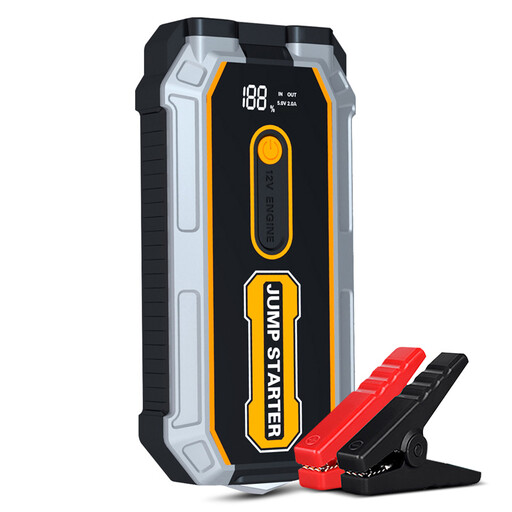
Why This Fits Their Persona: Ideal for drivers of small to medium-sized petrol or diesel cars who need a simple, reliable and ultra-compact solution. At just 330g, it fits easily in a glovebox or backpack without adding bulk, providing peace of mind for daily commutes and local journeys.
It focuses on the core function of jump-starting without adding complex secondary features that could fail. The 1200A peak current is a realistic rating for its size and is sufficient for most common UK cars, avoiding the inflated numbers trap.
Its primary advantage is its extreme portability and simplicity. The clear LCD display shows remaining power and it includes essential safety protections and a basic USB power bank function for emergencies.
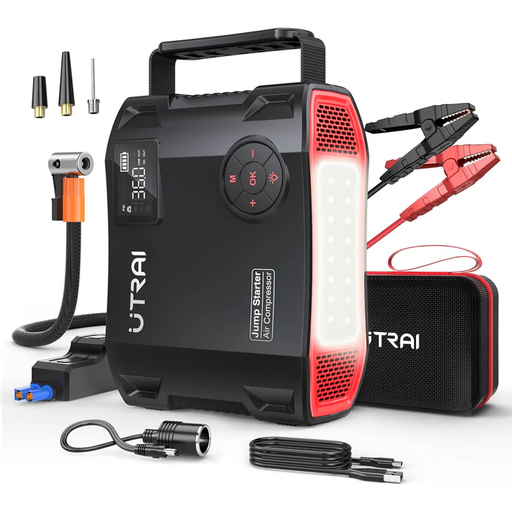
Why This Fits Their Persona: Perfect for drivers of larger family SUVs, MPVs, or vans who value preparedness. This all-in-one unit combines a powerful jump starter with a genuinely useful air compressor, making it ideal for long-distance travel, camping trips and managing family vehicle maintenance.
It avoids the "all-in-one" trap by delivering strong performance in both its primary and secondary functions. The 150 PSI compressor has a decent airflow of 45L/min and an auto shut-off, making it a practical tool rather than a gimmick.
Its versatility is its main strength. It has enough power for large 10.0L diesel engines, a fast-charging USB-C port, a powerful 1600-lumen LED light and a 160W DC output to power accessories like car fridges, making it a true roadside emergency hub.
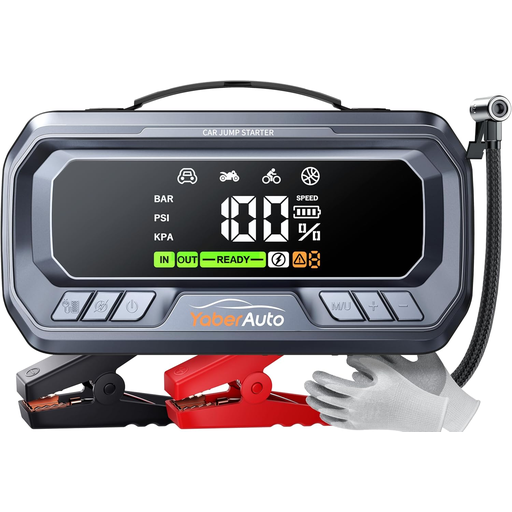
Why This Fits Their Persona: This is for the user who demands high performance and advanced features. It's suitable for large diesel engines (vans, 4x4s) and tech users who will appreciate the bidirectional 65W PD fast charging for laptops and other devices, plus a unique DC continuous output mode.
This unit justifies its high power rating with genuinely advanced features. The 65W PD fast charging is a significant step up from standard USB ports and the DC output mode provides a unique function that sets it apart from typical multi-function devices.
Its advanced power management is the key benefit. The ability to fast-charge a laptop at 65W and provide continuous DC power for accessories like dashcams after parking makes it a highly capable and versatile power hub, not just a jump starter.
We have compiled a complete, real-time list of products that fully satisfy these strict selection criteria and UK safety regulations.
To ensure it's ready for an emergency, it is advisable to recharge your jump starter every 3 to 6 months, even if it has not been used. This helps maintain the health of the internal lithium battery and prevents it from becoming deeply discharged, which can shorten its lifespan. Most models have an indicator to show the current charge level.
Yes, most modern portable jump starters are designed to withstand a wide range of temperatures, typically from -20°C to 60°C. They are built to be stored in a vehicle. However, extreme cold can temporarily reduce battery performance. For this reason, it's always a good idea to ensure the unit is fully charged before the winter months. Always check the manufacturer's specified operating temperature range.
Not necessarily. While a higher peak amp rating indicates more potential power, it's more important to match the jump starter to your vehicle's needs. A 1.4L petrol hatchback does not require a 6000A jump starter designed for a large diesel truck. Choosing a unit that is appropriately sized for your engine ensures you are not paying for power you will never use. Focus on the manufacturer's recommended engine size compatibility (e.g., "up to 6.0L petrol") for a more practical measure of its capability.