
24/7 Customer Support

Free returns

Same-day & Next-day Delivery

Quality Guaranteed

Unlock Your Welcome Offers: FREE Delivery | Up to 80% OFF | Free 30-day JoyPlus trial
Download the APP
Building an effective home gym in the UK often means making smart choices about space and equipment. If you're looking for a single piece of kit that can deliver a comprehensive upper body and core workout, a power tower for home gym use is an excellent starting point. This versatile piece of home strength training equipment combines multiple functions into a compact, vertical footprint, making it ideal for anyone serious about calisthenics or bodyweight training.
This guide is designed to help you navigate the options. We will outline the key features to consider before you buy and present a few of our top recommendations to help you find a model that suits your space, budget and fitness ambitions.
Choosing the right multi-function workout station involves more than just looking at the price. To ensure you get a safe, durable and useful piece of equipment, consider these three factors.
Safety and stability are paramount. A power tower needs to remain solid and wobble-free during exercises like pull-ups and dips. Look for models constructed from heavy-duty steel with a wide, H-shaped base for a low centre of gravity. Always check the manufacturer's stated weight capacity. For most users, a capacity of 400 LBS (approx. 181 kg) or more provides a strong foundation for safe and confident training, making it suitable as heavy duty calisthenics equipment.
Not all homes have high ceilings, and not all users are the same height. An adjustable power tower offers the flexibility to fit your space and your body. Before purchasing, measure the ceiling height of your intended workout area, leaving enough clearance above the pull-up bar for your head. Many models offer multiple height settings for the pull-up bar, which is also beneficial for households with more than one user.
At its core, a power tower is a pull up and dip station. However, many models offer much more. Standard features to look for include:
Some advanced models even include a power tower with bench, transforming the unit into a station for dumbbell presses and other free-weight exercises.
Here are a few models that stand out for their features, construction and user-focused design.
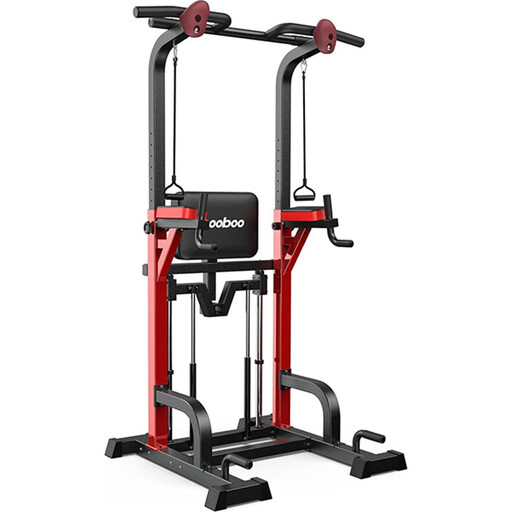
Why It Stands Out: The standout feature of the C773 is its integrated resistance assisted pad. This makes it an excellent choice for those who are still building the strength required for unassisted pull-ups, allowing for progressive training.
Pros:
Who is it for? Beginners and intermediate users who want to progressively master bodyweight exercises like pull-ups and dips.
Learn More about the Pooboo C773 Power Tower
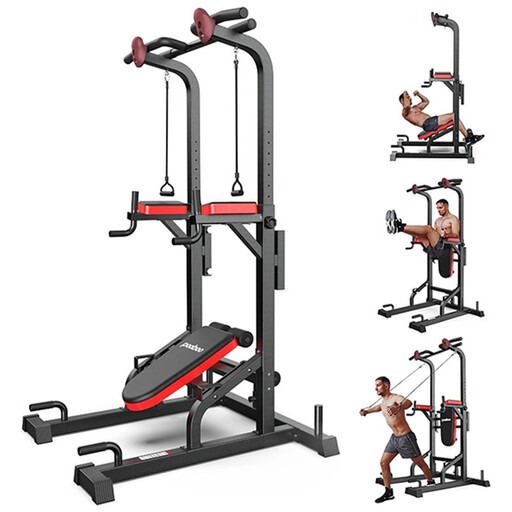
Why It Stands Out: This model is a true all-in-one home gym solution. The inclusion of a foldable weight bench dramatically expands its utility, allowing for dumbbell presses, rows and other exercises. The rock-climbing grips on the pull-up bar also offer a unique challenge for building grip strength.
Pros:
Who is it for? Fitness enthusiasts who want a single station for both bodyweight calisthenics and free-weight training.
Learn More about the Pooboo Multifunction Power Tower with Bench
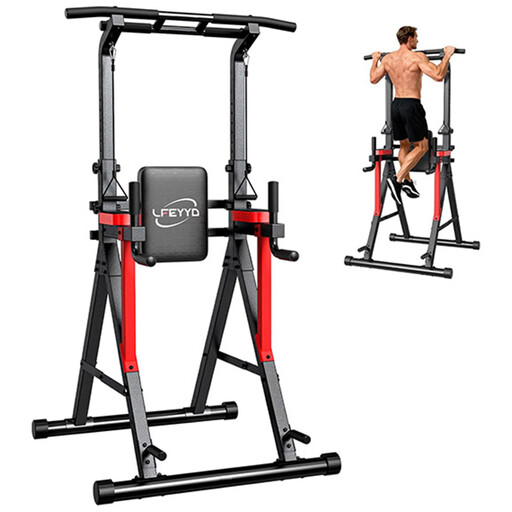
Why It Stands Out: The key advantage of this free standing pull up bar is its exceptional adjustability. With 13 different height levels, it can be precisely tailored to users of virtually any height, making it a fantastic option for family use or for those who want to fine-tune their exercise setup.
Pros:
Who is it for? Taller individuals or households with multiple users who need maximum height customisation.
Learn More about the Pooboo 13-Level Adjustable Power Tower
If these specific models aren't quite what you're looking for, or if you'd like to compare them against other designs, there is a wider selection available. You can explore different configurations and features to find the perfect fit for your home gym.
Discover more options in our full range of pull up equipment.
For many people, a power tower is one of the most space- and cost-effective investments for a home gym. It consolidates four or more pieces of equipment (pull-up bar, dip station, leg raise machine and push-up bars) into one, allowing for a full-body workout without taking up excessive floor space.
A standard power tower enables a wide range of compound exercises that build functional strength. These include pull-ups and chin-ups (back and biceps), dips (chest and triceps), vertical leg and knee raises (abdominals and hip flexors) and push-ups (chest and shoulders).
You should measure the equipment's footprint (length and width) and ensure you have that clear floor space on a level surface. Crucially, also measure your ceiling height. You will need enough room above the highest point of the pull-up bar to perform a full pull-up without hitting your head—typically an extra foot of clearance is a good rule of thumb.