For a projector that will stay to one side, prioritise a model that explicitly offers horizontal lens shift. For occasional viewing from a side table, horizontal keystone correction offers more flexibility, but keep the projection angle modest: substantial digital correction can reduce usable image area and light output. Check the required image size at your available distance and how you will play the family videos before choosing either setup.
Who is this setup for?
Viewers with a fixed side position
If the projector will stay on an offset shelf or ceiling mount, check for horizontal lens shift and a zoom range that works at the planned distance. A specification that says only “lens shift” may refer to vertical movement.
Families who put the projector away
For occasional video nights from a side table, horizontal keystone correction can make changing positions easier. Check which adjustments work automatically and whether they have distance or angle limits.
Viewers playing clips from several devices
If family videos come from a phone, tablet or laptop, work out the connection path before buying. Casting support varies by device and model; an HDMI connection may be useful for a compatible video source.
What matters when choosing?
Start with where the projector can stand and the image size you want, then check how you will connect your videos and hear them from the viewing seats.
| Concern |
What to check |
Who this matters to |
| Image from an offset position |
For a fixed position, look specifically for horizontal lens shift. Otherwise, confirm horizontal rather than vertical-only keystone correction. |
If the projector stays on a side shelf, I want the picture aligned without relying heavily on digital correction; around 38% of consumers put image quality in a fixed side position first. |
| Repeated setup |
Check the directions and limits of automatic keystone correction, plus autofocus or screen-fit features where offered. |
When I bring out the projector for video nights, I want to spend less time readjusting it; roughly 23% of consumers prioritise quick setup. |
| Video-source connection |
Match the intended phone, laptop or media player to the model’s stated HDMI inputs, casting method or supported apps. |
Our clips are spread across devices, so I need a playback method that works with the one we will use; about 23% of consumers put connection convenience first. |
| Room fit and sound |
Compare the available projection distance and intended image size with the exact model’s throw information; check its sound and audio-output options. |
I need the image to fit the available wall and the sound to reach our seats; around 16% of consumers prioritise room fit and listening comfort. |
Side-placement mistakes to avoid
-
Assuming any keystone feature handles side projection
Vertical correction addresses an up-and-down tilt, not a projector positioned to the left or right. Automatic correction can also have placement limits.
Check the exact model for horizontal keystone, four-corner adjustment or horizontal lens shift. BenQ specifies a distance condition of within 2 m for automatic side correction on the GV50P.
-
Planning around a severe projection angle
ProjectorCentral explains that substantial digital keystone correction can leave part of the display unused, reducing usable resolution and light output.
Position the projector as square-on to the wall or screen as the room allows, then use correction to finish aligning the image.
-
Choosing an image size before measuring the room
Side-correction features cannot establish whether a projector will produce the intended image size at the distance available.
Measure the projection distance and usable wall width, then check the exact model’s throw and zoom information against those measurements.
-
Assuming a smart interface plays every family video
Casting methods, device support and app availability differ by model. A network-connected interface does not establish compatibility with a particular phone or video service.
Identify the device or service you will use, check its stated connection method, and review the declared security-update support period for a connected model.
Relevant brands to consider
Epson
Epson has home-cinema models with different placement adjustments that are worth comparing for a fixed installation.
- Epson lists lens shift, optical zoom and keystone correction for the EH-TW7000; the EH-LS12000B specification explicitly lists horizontal and vertical lens shift.
- Check the direction and range on the exact model. “Lens shift” alone does not establish that the image can move horizontally.
BenQ
BenQ offers models with digital side-position correction, including options for temporary placement.
- BenQ specifies horizontal keystone correction for the W2710i and automatic horizontal correction for the portable GV50P.
- These adjustments are not horizontal lens shift. BenQ states that the GV50P’s automatic side-correction specification has a 2 m distance condition.
ViewSonic
ViewSonic has home-projector models with geometric adjustment features for rooms where central placement is difficult.
- ViewSonic lists vertical lens shift, optical zoom, horizontal and vertical keystone, and four-corner adjustment for the X1-4K.
- The X1-4K’s stated lens shift is vertical; use its exact specifications rather than assuming it offers horizontal optical shift or that other models share its adjustments.
Joybuy projectors for side placement
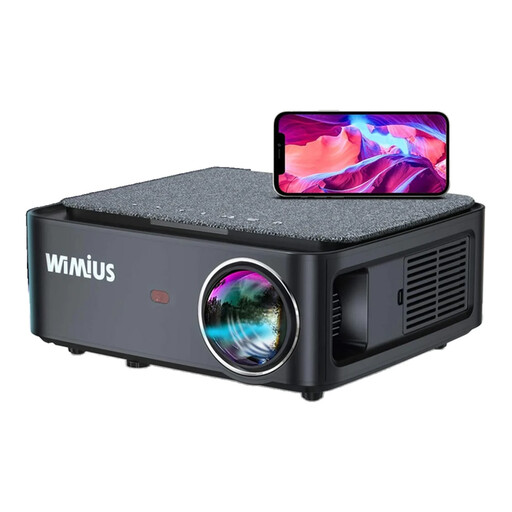
This projector lists horizontal and vertical keystone correction, making it relevant to a movable side-position setup. Check whether its placement limits, image size and connection method work in your room.
 No image available
Wimius K1 FHD 1080p Projector
For an occasional side-table position, the listing names both horizontal and vertical keystone correction. It lists FHD 1080p and 1200 ANSI lumens; check the image size possible at your available distance rather than relying on the advertised maximum screen size. The listing also gives a 30° projector-inclination limit, so plan to keep the unit as square-on as practical and confirm how your video source will connect.
View on Joybuy
Frequently asked questions
Can a projector show family videos from the side of the room?
Yes, if its placement adjustments suit the angle and distance. For a fixed offset position, check for horizontal lens shift; for temporary placement, look for stated horizontal keystone correction and keep the angle modest.
Is vertical keystone enough for a side table?
No: vertical keystone addresses up-and-down tilt, not a projector standing to one side. Look for horizontal correction, horizontal lens shift or suitable geometric adjustment on the exact model.
Should I choose a smart projector to play videos from my phone?
Choose one only after checking that its stated casting method works with your phone and the videos or services you use. An HDMI input offers another route through a compatible device or adapter; for a connected projector, also check its declared security-update support period.
What should I do with an old projector?
Use an electrical-equipment recycling route rather than general household waste. GOV.UK describes retailer take-back responsibilities for electrical goods; ask the seller about its process or check a local collection option.


