
24/7 Customer Support

Free returns

Same-day & Next-day Delivery

Quality Guaranteed

Unlock Your Welcome Offers: FREE Delivery | Up to 80% OFF | Free 30-day JoyPlus trial
Download the APP
There's nothing quite like gliding across the water on a stand-up paddleboard on a sunny British afternoon. But before the bliss comes the prep, and for many, that means the strenuous, time-consuming task of manual pumping. A rechargeable electric sup pump promises to save your energy for the water, but navigating the market can be tricky. Many products come with overhyped claims that lead to buyer's remorse.
As the Joybuy Product Recommendation Officer, my role is to help you sidestep these issues. We'll look past the marketing noise and focus on what truly matters, ensuring you find a reliable pump that gets you from car park to coastline with minimal fuss. Here are the common pitfalls to watch out for.
To avoid these traps, focus on a few key technical specifications. These non-negotiable parameters are the true indicators of a pump's performance and longevity.
Understanding the power source is the first step.
Your inflatable paddleboard has a recommended PSI (pounds per square inch), typically between 15 and 18 PSI.
A truly fast paddle board inflator is efficient in both stages of inflation.
Instead of a one-size-fits-all approach, we've matched some well-regarded models to different user needs.
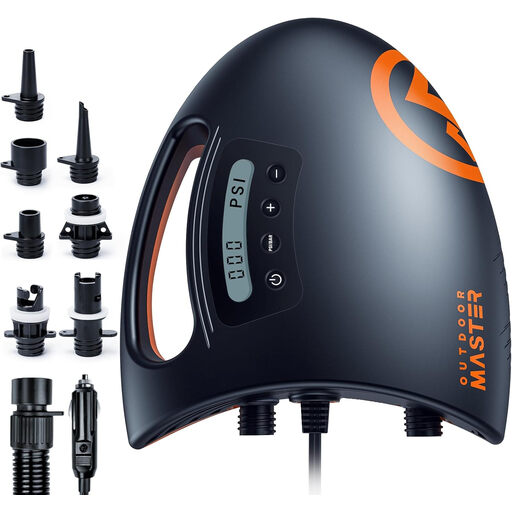
Why This Fits Their Persona: This user always drives to their launch spot and inflates their gear right by the car. The Shark2's 12V DC connection is a straightforward, reliable solution that removes any worry about battery levels, making it a cost-effective workhorse.
It directly counters the overheating pitfall with its specified active cooling system, allowing for the inflation of up to three boards consecutively. It also avoids the battery mirage by being an honest, plug-in-only device.
Reliable 12V power source and an active cooling system for multi-board inflation. Includes a deflation function for quick pack-up.
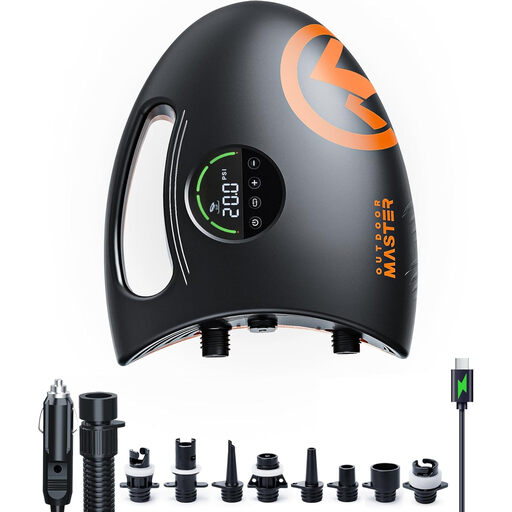
Why This Fits Their Persona: This user wants the freedom to inflate their board anywhere. The Shark2S's large integrated battery provides true portability for family days out or adventures with friends, without being tethered to a vehicle.
Its substantial 88.8Wh rechargeable battery directly addresses the "battery life mirage," providing enough stated capacity for up to 6 boards. This is a verifiable specification that promises real-world performance.
Excellent battery capacity for multi-board inflation. It also functions as a power bank for charging devices and offers flexible charging options (Type-C and 12V DC).
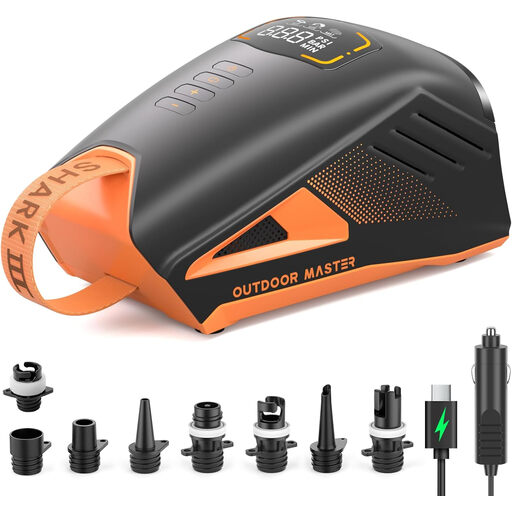
Why This Fits Their Persona: For the frequent paddler, time is precious. The OutdoorMaster Shark 3 is built for speed, aiming to get you on the water faster than almost any other portable pump. Its rapid inflation and quick recharging are ideal for those who want maximum efficiency.
It tackles the "fast inflation myth" head-on by providing a specific, impressive time: inflating a 10.6ft board to 15 PSI in just 3 minutes and 50 seconds. This is a clear, verifiable performance metric.
Extremely fast inflation time to maximise time on the water. The 74Wh battery supports up to 4 boards and recharges quickly via a 45W Type-C input.
We have compiled a complete, real-time list of products that fully satisfy these strict selection criteria and UK safety regulations.
The lifespan of a portable paddle board pump depends on two factors: the battery and the motor. The lithium-ion battery can typically handle several hundred charge cycles before its capacity begins to diminish. The motor's longevity is improved by choosing a model with a good cooling system and a PSI rating higher than your board requires, as this reduces strain. With proper care, such as cleaning the air filter and storing it in a dry place, a quality pump should provide reliable service for many seasons.
No, you should not use a car tyre inflator. While they are designed for high pressure, they operate at a very low volume (air flow). A paddleboard requires a huge volume of air. Using a tyre inflator would take an exceptionally long time to fill a board, and the inflator would likely overheat and fail long before the job is done. A dedicated electric air pump for inflatables like a SUP is designed for high volume first, then high pressure.
It is highly recommended. A pump rated for 20 PSI will reach 15 PSI much more comfortably and efficiently than a pump that has a maximum rating of 15 PSI. It puts less stress on the motor and components, leading to faster inflation in the crucial high-pressure stage and a longer overall lifespan for the pump.