Fast-choreography viewers
If turns, lifts and group routines are your priority, compare motion settings using footage like the programmes you actually watch. A high refresh-rate label alone cannot tell you how a dance broadcast will look.


Choose for your room as well as the dance footage you watch. OLED or QD-OLED is worth considering when you can darken the room and care most about contrast between spotlit performers and the stage; LED-based TVs also deserve consideration in a multipurpose room, but their reflections need checking. Whichever route you take, try familiar choreography with the TV’s motion settings rather than treating a refresh-rate figure as proof of broadcast picture quality.
If turns, lifts and group routines are your priority, compare motion settings using footage like the programmes you actually watch. A high refresh-rate label alone cannot tell you how a dance broadcast will look.
If you can control the lighting, look closely at detail around spotlights, dark stage areas and colourful costumes. OLED and QD-OLED models are relevant options, but assess the exact screen in your room.
If you watch with daylight or lamps on, check whether reflections obscure dark scenes from your usual seats. Consider room-light visibility alongside colour and contrast claims.
Consider it when: You can darken the room and want to examine contrast between performers, spotlights and the stage.
Keep in mind: The display type does not establish how a particular TV processes broadcast motion, and reflections still matter.
Consider them when: You use the room for more than darkened viewing and want to compare QD-Mini LED or Micro RGB models under your usual lighting.
Keep in mind: Brightness and colour claims do not establish how well the exact screen handles your room’s reflections.
| Concern | Buying checks | Who this matters to |
|---|---|---|
| Fast-moving choreography | Try dance or similar footage with motion processing low, higher and off. Look for stable outlines without distracting smoothing or halos. | If rapid routines are hard to follow, I want movement to stay readable without looking artificial. Around 33% of consumers put motion clarity first. |
| Dark-stage contrast and colour | Watch a dark scene with bright spotlights and colourful costumes; check detail from your usual seats. | In a darkened room, I care most about seeing performers against the stage without losing costume detail. For around 27% of consumers, contrast and colour are the primary concern. |
| Daylight and reflections | Check a dark scene with your usual lamps or daylight present, including reflections at the intended screen position. | When I cannot darken the room, I need to see the performance clearly despite windows or lamps. Bright-room visibility comes first for around 20% of consumers. |
| Screen and sound-system fit | Measure the seating position and available space; confirm the exact TV’s stand or mounting dimensions and the connections your audio setup needs. | Before choosing a larger screen, I need it to fit the room and work with my sound system. Around 20% of consumers make that setup their main priority. |
TCL lists a 144Hz native panel for the C8K, while LG advertises up to 165Hz in 4K for the C6. Neither figure establishes how an ordinary dance broadcast will look after the TV processes it.
Compare motion settings using choreography or other rapid camera movement, watching for unnatural smoothing and artefacts around dancers.
Contrast, colour and brightness claims cannot show what a window or lamp will reflect at your intended screen position.
View a dark scene under your usual lighting. If you can darken the room, examine stage contrast; if you cannot, give reflections and visibility more attention.
A home-cinema setup may also call for a suitable stand or mount, installation and a connection to external sound.
Decide how the TV will be positioned and connected before ordering, and check the arrangements for delivery, installation and old-TV collection.
Wall mounting, cable routing and external audio can add work to the setup.
TV Licensing says a TV Licence is required to watch live TV on a channel or streaming service, and to use BBC iPlayer. The requirement depends on what you watch, not whether the screen is a smart TV.
Check whether you plan to watch the competition live, on BBC iPlayer or on demand through another service.
These examples point to particular TV lines, not a judgement about every model from each brand.
The OLED evo C6 line is relevant to viewers considering OLED for a home cinema.
The R85H Micro RGB line is an LED-based option to examine for a multipurpose room.
The C8K QD-Mini LED line is relevant when motion-related specifications are on your shortlist.
BRAVIA 8 II is a QD-OLED line for viewers comparing contrast-led home-cinema options.
These QD-Mini LED, Mini-LED and QLED TVs offer different screen sizes and stated features to compare for dance viewing. Check motion with familiar footage and assess each screen under your room’s lighting before deciding.
 No image available
Consider this model if a 75-inch screen fits your home-cinema space and you can audition its motion settings with dance footage.
The title specifies 4K HDR, a 144Hz native refresh rate, up to 2048 local dimming zones, Google TV and audio by Bang & Olufsen. Check the exact dimensions and how the screen handles your room’s reflections.
 No image available
This 55-inch option is worth examining if that size suits your seating and you want to compare motion settings for fast routines.
Its title lists 4K HDR, VIDAA OS, 165Hz Game Mode Ultra and a built-in subwoofer. The gaming-mode figure does not establish how a dance broadcast will look; check motion and reflections yourself.
 No image available
Consider this 55-inch model if screen fit and its stated built-in audio are important to your setup.
The title specifies 4K HDR, an ONKYO 2.1 sound system and a 288Hz Game Accelerator feature. Treat that figure as a gaming-feature claim, not the refresh rate of dance broadcasts; confirm the relevant mode and assess motion in person.
 No image available
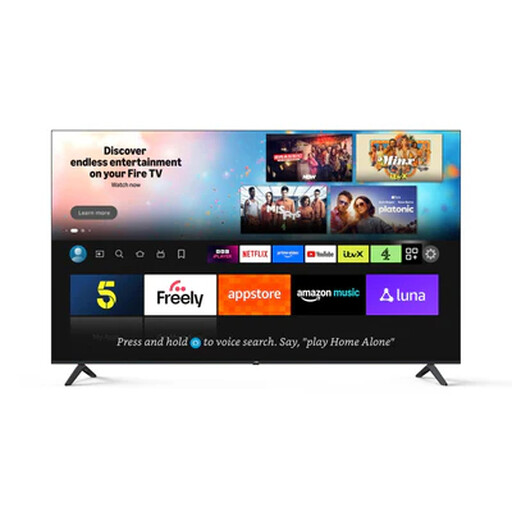
This 65-inch model is relevant if its screen size fits your room and you want to check whether its built-in viewing services carry your programmes.
The title specifies 4K Ultra HD, HDR10+, Dolby Audio, Freely and Fire TV. Confirm programme availability and assess motion and reflections with the content you expect to watch.
 No image available
If 65 inches is a better fit than the 75-inch 75Q7C, this variant gives you a separate size to assess for the same dance-viewing priorities.
Its title specifies 4K HDR, a 144Hz native refresh rate, up to 2048 local dimming zones, Google TV and audio by Bang & Olufsen. Confirm this variant’s dimensions and assess broadcast motion and room reflections before choosing.
Yes, TV Licensing says you need to be covered by a TV Licence to watch live TV on a channel or streaming service. BBC iPlayer also requires one, including for on-demand programmes; on-demand viewing through other services does not, by itself, require a TV Licence.
No: a stated refresh-rate capability does not establish how a TV will process ordinary dance broadcasts. Compare familiar choreography with different motion settings and watch for halos, unnatural smoothing or movement you find difficult to follow.
Not on wall width alone. Check your seating position, the exact TV’s dimensions with and without its stand, the intended mount or furniture, cable routes and any external-audio connections before ordering.
Arrange an appropriate electrical-waste route, such as a retailer collection option or a local authority facility, rather than putting the TV in ordinary household waste. GOV.UK explains that UK waste electrical and electronic equipment rules support recovery and recycling; confirm the collection arrangements available to you.