
24/7 Customer Support

Free returns

Same-day & Next-day Delivery

Quality Guaranteed

Unlock Your Welcome Offers: FREE Delivery | Up to 80% OFF | Free 30-day JoyPlus trial
Download the APP
Mounting your television to the wall is a fantastic way to reclaim floor space, achieve a clean, modern aesthetic and create the perfect viewing angle. However, the path to a securely mounted TV is filled with potential missteps. Many shoppers find themselves with a bracket that doesn't fit, isn't safe for their wall type or simply fails to deliver the flexibility they expected.
As the Joybuy Product Recommendation Officer, my role is to help you navigate these choices. Before you add a TV wall mount to your basket, let's look at the common pitfalls that can lead to frustration and wasted money.
To ensure a successful and safe installation, focus on these three core parameters. Getting them right is more important than any marketing feature.
Turn your TV around, and you will likely see four screw holes in a square or rectangular pattern. The distance between these holes is a standardised measurement known as the VESA mount interface standard. It might be 100x100mm for a small screen or 400x400mm for a larger one.
Before purchasing any TV wall mount, you must confirm two things:
A mismatch here means the bracket simply will not attach to your television.
Every mount has a maximum weight capacity. This figure must be higher than the weight of your television. Do not estimate; check your TV's official specifications.
Equally important is your wall's construction. For a secure fit, a TV wall mount must be anchored into a solid, load-bearing structure.
Consider how you will use your TV to choose the right type of bracket.
Based on these practical criteria, we've matched a few options to different user needs.
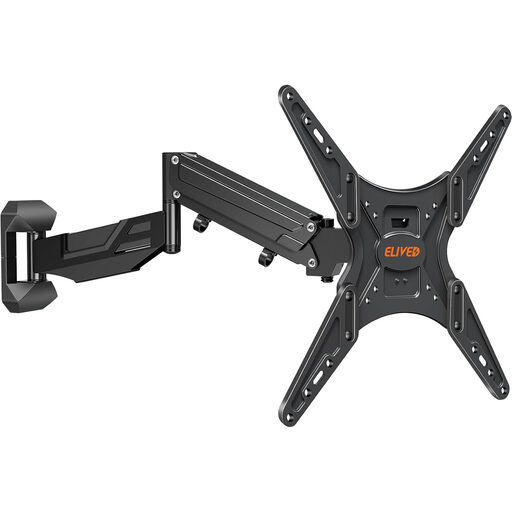
Why This Fits Their Persona: Ideal for those with a dynamic living space. If you watch TV from the sofa, a dining table or an open-plan kitchen, the smooth gas spring arm allows for effortless repositioning to get the perfect view from anywhere, including corners.
This mount counters the "full-motion fallacy" with a generous 180° swivel, 515mm extension and 219mm of height adjustment, providing true flexibility.
The gas spring mechanism allows for smooth, one-touch height and depth adjustment. It supports a wide range of VESA patterns for TVs up to 55 inches, including a TV bracket for curved TV models.
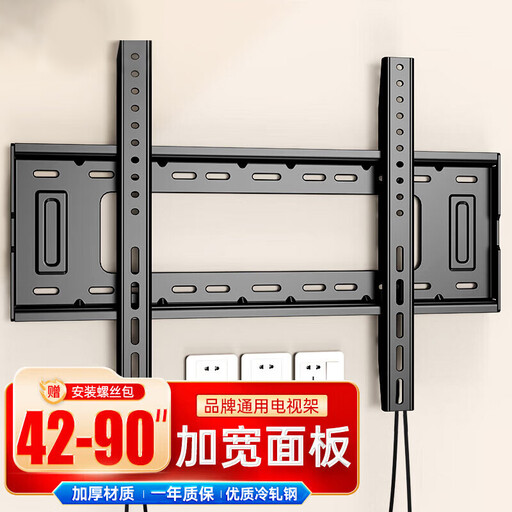
Why This Fits Their Persona: For those with a large screen who prioritise a secure, unobtrusive setup. This fixed mount is designed for strength and simplicity, keeping the TV close to the wall for a sleek, picture-frame appearance in the living room or home cinema.
This mount directly addresses the "mismatched mount" pitfall by being specifically engineered for large, heavy televisions up to 90 inches, with a robust build to handle the load safely.
Its primary benefit is its strength and low-profile design. The simple locking mechanism ensures the TV is held securely in place, providing peace of mind for owners of large and expensive screens.
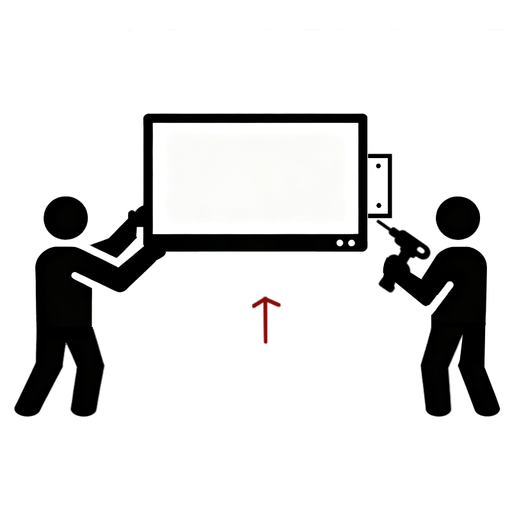
Why This Fits Their Persona: Perfect for anyone who values convenience and safety above all. If you're not confident with DIY, don't own the right tools or simply want a guaranteed-perfect result, a professional service is the most sensible choice.
This service eliminates every pitfall. The installer handles VESA and weight checks, assesses your wall type, uses the correct fixings and ensures a level, secure fit, avoiding the "plasterboard peril" entirely.
The main advantage is complete peace of mind. A professional TV installation ensures your expensive equipment is mounted safely and correctly, with no risk of damage to your TV or your wall.
We have compiled a complete, real-time list of products that fully satisfy these strict selection criteria and UK safety regulations.
You should not mount a TV directly onto a plasterboard surface. These materials are not strong enough to support the weight and leverage of a television. Instead, you must use a stud finder to locate the wooden studs behind the plasterboard and fix the mount securely into these structural supports. If you are unsure, booking a TV mounting service is the safest option.
The simplest way is to check your TV's user manual or the manufacturer's website for its specifications. Alternatively, you can measure it yourself. Use a tape measure to find the distance in millimetres between the centres of the four mounting holes on the back of your TV, first horizontally and then vertically. This will give you the VESA pattern (e.g., 400mm x 200mm).
This depends entirely on your room and viewing habits. If your seating is directly in front of the TV and at the correct height, a simple fixed TV wall mount is a cost-effective and secure solution. However, if you need to angle the screen to avoid reflections, watch from different parts of the room or fit the TV into an awkward corner, the flexibility of a full motion TV bracket is well worth the investment.