
24/7 Customer Support

Free returns

Same-day & Next-day Delivery

Quality Guaranteed

Unlock Your Welcome Offers: FREE Delivery | Up to 80% OFF | Free 30-day JoyPlus trial
Download the APP
A perfectly manicured lawn without lifting a finger is the promise of a wireless robot lawn mower. For UK homeowners, especially those with busy lives or limited mobility, the idea of an automatic mower that just works is incredibly appealing. However, the market is filled with models that over-promise and under-deliver, leading to frustration and a poorly-kept garden.
Before you invest, it’s crucial to understand the common traps. Many buyers find themselves with a device that gets stuck, misses patches or can't handle the gentle inclines of a typical British garden. Here are the key issues to watch out for.
To ensure your new mower is a helpful garden assistant rather than a costly garden ornament, focus on these non-negotiable specifications.
The key to a truly autonomous experience is the navigation technology. Instead of just looking for "AI" on the box, investigate the type of system it uses.
For many UK gardens, even a slight incline can defeat a poorly designed robot mower.
It is vital to match the mower's capacity to your garden's size.
We've analysed the market based on the critical parameters above. Instead of a simple list, we match products to the people they are designed for.
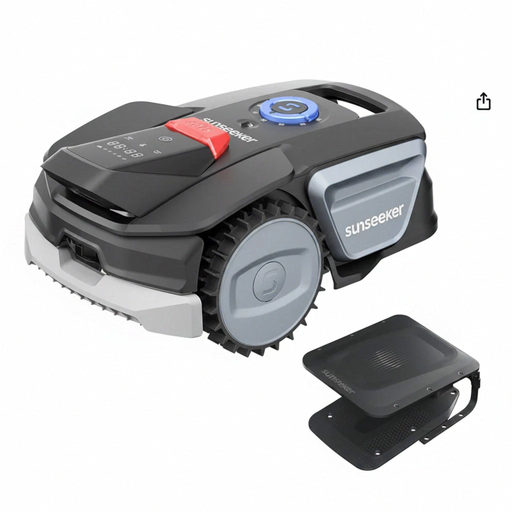
Why This Fits Their Persona: This model is ideal for owners of modern UK homes with gardens up to 300m?. Its wire-free setup is perfect for those who value convenience, and its ability to handle sloped terrain makes it a practical choice for gardens that aren't perfectly flat. The app control and one-key mowing function appeal directly to a tech-literate user.
The Sunseeker V1 lawn mower directly counters the pitfalls. Its AI Vision system provides genuine smart navigation without wires, avoiding the "bump-and-turn" trap. Furthermore, its specified 27% slope capability is a verifiable metric that addresses the problem of exaggerated performance claims.
The main advantage is the combination of a wire-free setup and reliable slope handling. Pros include its intelligent obstacle avoidance, one-key start function for simplicity and the inclusion of a garage for weather protection.
Here are answers to a few common questions UK buyers have about wireless robot mowers.
No, their setup is generally much simpler than models requiring a boundary wire. For an AI Vision mower, the process typically involves placing the charging station, downloading the companion app and letting the mower perform an initial scan of your lawn's perimeter. This is far less labour-intensive than burying a wire around your entire garden.
High-quality AI mowers are designed to prevent this. Their vision systems are trained to recognise common obstacles like furniture, toys and pets, and to identify the boundary between grass and flowerbeds. They navigate around these objects rather than bumping into them, offering better protection for your garden and the mower itself.
Battery life depends on the model and the complexity of your garden. For a robotic lawn mower for small gardens (e.g., up to 300m?), a single charge is typically sufficient to mow the entire area. Most modern units will automatically return to their charging base when the battery is low and, if needed, resume mowing once they have enough power.