
24/7 全天候客户支持

免费退货

当日/次日达

品质保障

开启新人专享福利: 全场免邮 | 低至 2 折 | 免费试用 30 天 JoyPlus 会员
下载 Joybuy
A flat battery on your phone or laptop during a crucial moment on the road is a frustration many of us know too well. In an age where we rely on multiple devices for navigation, communication and entertainment, the simple cigarette lighter socket in your vehicle holds more potential than ever. But with so many options available, from simple USB plugs to powerful inverters, choosing the right car charger can feel overwhelming.
This guide is designed to help you understand the key features to look for and to highlight a few standout options that cater to different needs, whether you're a daily commuter, a family on a road trip or a professional working from your vehicle.
Before diving into specific products, let's cover a few key considerations. Thinking about these points will help you narrow down what you truly need from a vehicle charging solution.
The most critical factor is how much power a charger can deliver and how quickly. This is measured in Watts (W). A basic 5W charger will slowly top up a phone, but for modern devices, you'll want more. Look for support for fast-charging standards:
For power-hungry devices like a laptop car charger, you'll need significantly higher wattage, often 65W or more.
Think about how many devices you and your passengers need to charge simultaneously.
Finally, consider the physical design. Do you want a tiny, flush-fitting charger that barely protrudes from the dash, or do you need a more substantial unit with built-in cables or AC outlets? Some models come with retractable cables to keep your console tidy, while others are built into a larger cigarette lighter adapter that might offer extra sockets.
Here are three different types of in-car charging solutions, each suited for a particular set of needs.
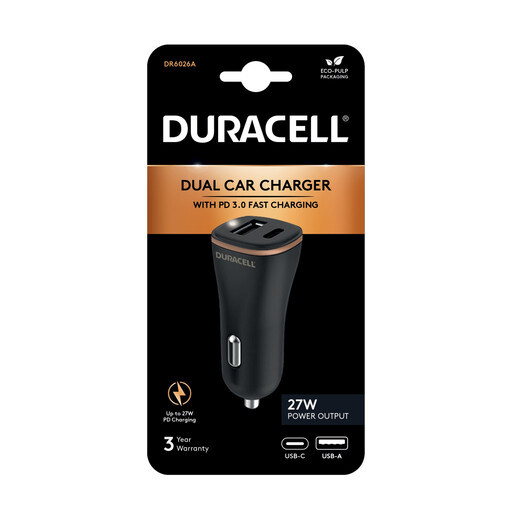
Why It Stands Out: This charger combines a compact, durable design with the reliable performance associated with the Duracell name. It offers a practical solution for keeping modern devices charged without cluttering your dashboard. The inclusion of both USB-A and USB-C ports ensures broad compatibility.
According to the manufacturer, its 27W PD Fast Charging technology provides optimised charging that is up to four times faster than a standard 5W charger for compatible devices.
Pros:
Who is it for? This is an excellent choice for daily commuters and individual drivers who need a simple, reliable way to fast-charge their smartphone and perhaps another small device like headphones or a sat-nav.
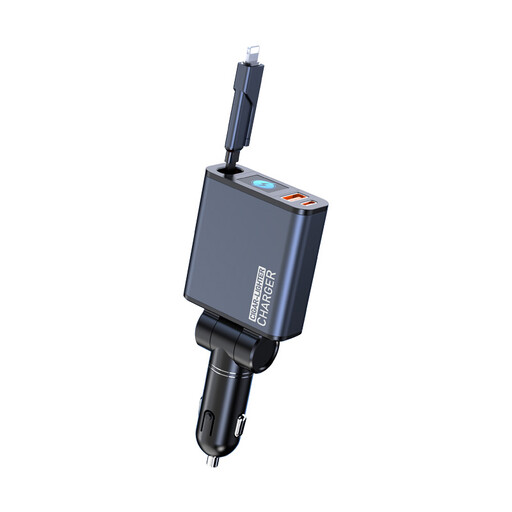
Why It Stands Out: The ATSHARK K006S is a powerhouse designed for those who need to charge multiple, high-demand devices at once. Its standout feature is the dual retractable cables, which eliminate tangled wires and keep the car's interior neat. With a massive 160W total output, it can comfortably handle laptops, tablets and phones simultaneously.
It supports a wide range of fast-charge protocols, including QC5.0 and PD3.0, and features an intelligent chip to deliver the optimal power to each connected device.
Pros:
Who is it for? This is geared towards business professionals who work on the go, tech-savvy families with multiple power-hungry gadgets and anyone who needs a serious laptop car charger without the bulk of an inverter.
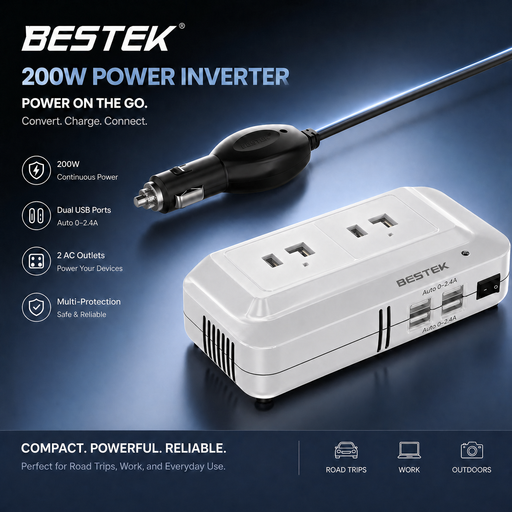
Why It Stands Out: The BESTEK 200W Power Inverter goes beyond standard USB charging. By converting your car's 12V DC power to 230V AC, it allows you to run devices that require a standard UK wall plug. With two AC outlets and four USB ports, it can power up to six devices at once, making it a mobile power hub.
Its compact size and 73cm cord allow for flexible placement, whether in the front console or for passengers in the back.
Pros:
Who is it for? Ideal for campers, tradespeople and families on long road trips. If you need to charge camera batteries, use a breast pump, power a laptop that requires its original AC adapter or run a small electrical device, this car power inverter is the solution.
If the models above don't quite match what you're looking for, or if you'd like to compare more specifications, there are many other solutions available.
? Explore our full range of AC adapter charger options to find the perfect fit for your vehicle.
1. Can a car charger drain my car's battery? When the engine is running, the car's alternator powers the charger, so it won't drain the battery. If the engine is off but the cigarette lighter socket is still active, a charger will draw a very small amount of power. While it would take a long time to drain a healthy car battery, it's good practice to unplug chargers and inverters when the vehicle is parked for an extended period.
2. What is the difference between a car charger and a car power inverter? A standard car charger is designed to charge low-voltage DC devices like smartphones and tablets via USB ports. A car power inverter is a more powerful device that converts your car's 12V DC electricity into 230V AC electricity, the same as you get from a wall socket at home. This allows you to power devices that have a standard three-pin plug.
3. Do I really need a fast car charger for my phone? If you have a modern smartphone, a fast car charger with PD or QC technology can make a significant difference, especially on short journeys. It can charge your battery from nearly empty to 50% or more in around 30 minutes, whereas a standard charger might only add a few percentage points in the same amount of time. For older devices without fast-charging capability, a standard charger will work just fine.