
24/7 Customer Support

Free returns

Same-day & Next-day Delivery

Quality Guaranteed

Unlock Your Welcome Offers: FREE Delivery | Up to 80% OFF | Free 30-day JoyPlus trial
Download the APP
A digital kitchen scale can make baking more consistent, simplify meal preparation and reduce guesswork when weighing portions. However, not every electronic food scale is equally suitable for a busy UK kitchen. A slim model may be convenient but struggle with a large mixing bowl, while an app-connected scale can offer more functions than you will realistically use.
As the Joybuy Product Recommendation Officer, I focus on practical specifications rather than polished marketing language. Here are the common buying traps to avoid, the features worth checking and our top recommendations for different cooking styles.
A screen showing several decimal places does not automatically mean the scale measures accurately at that level. For everyday cooking, a 1g graduation is generally suitable for flour, sugar, vegetables and portioning. For coffee, spices or very small quantities, a 0.1g increment may be more appropriate.
Also check the minimum weighing amount. A scale with a high maximum capacity may not be designed for tiny measurements, which is why dedicated precision kitchen scales can be more useful for espresso, tea or herbs.
Many kitchen scales support up to 5kg, which covers most home baking and cooking tasks. If you regularly prepare large batches or weigh food in substantial containers, check the maximum capacity and the usable platform size.
A scale must also remain stable with the bowl placed centrally. A compact surface can be awkward when weighing dough or ingredients for batch cooking, even if its advertised capacity appears sufficient.
A smart nutritional scale or Bluetooth kitchen scale may connect to an app for calorie and nutrient logging. This can help meal-preppers and fitness users, but check the supported app ecosystem, phone compatibility and whether the food database suits your routine.
App-based nutritional figures are typically estimates based on database entries and serving information. They should not be treated as medical or dietary advice. If you only need recipe measurements, a straightforward model with a tare function may be more practical and economical.
For most kitchen scales for baking and kitchen scales for cooking, look for:
Remember that weighing liquids by volume can vary according to density. Measuring in grams is often more consistent for recipe work.
Scales with a tare function let you place a bowl on the platform, reset the display to zero and add ingredients one at a time. This reduces washing-up and makes “bowl-on-scale” recipes quicker.
Touch controls are easy to wipe clean, while physical buttons may be preferable if your hands are wet or covered in flour. Automatic shut-off can conserve battery power, but check how quickly it activates if you work slowly through a recipe.
Tempered glass and stainless steel platforms are smooth and generally easy to wipe, but electronic scales should not be immersed in water or placed in a dishwasher unless the instructions specifically allow it. Check the product dimensions before buying, particularly if you plan to store the scale in a shallow drawer.
For battery-powered models, look for low-battery and overload indicators. If you want to avoid disposable batteries, a kinetic or rechargeable design may better suit your household.
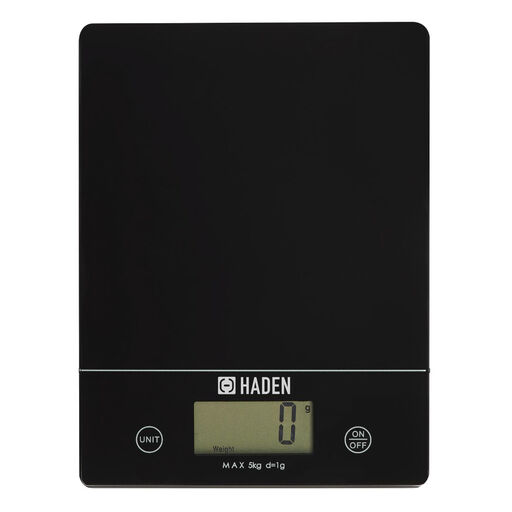
Why This Fits Their Persona: A practical choice for UK households starting with baking, everyday cooking or portion control, with a slim format and small footprint suited to flats.
Its stated 5kg capacity and 1g graduations are clearly defined, avoiding vague claims about precision.
Tempered glass platform, touch controls, LCD display and g, oz and lb unit options.
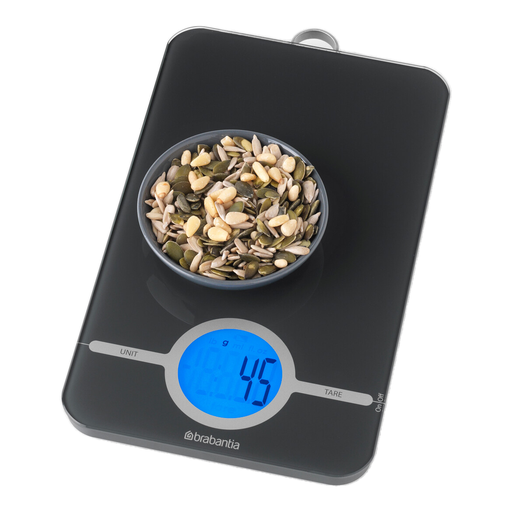
Why This Fits Their Persona: Suits regular bakers who want a spacious platform, illuminated display and convenient storage without moving to a multifunctional appliance.
The product information specifies 1g graduations, up to 5kg capacity and an add-and-weigh tare function.
Backlit LCD display, batteries included, hanging hook and stated five-year guarantee.
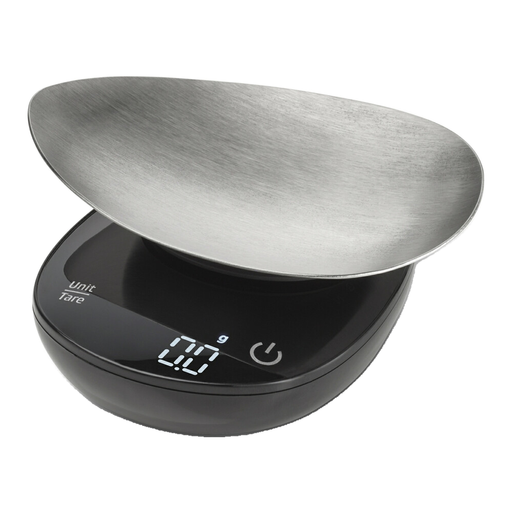
Why This Fits Their Persona: Designed for coffee enthusiasts and cooks measuring spices, tea or herbs in small quantities rather than large bowls.
Its 500g maximum capacity is paired with stated 0.1g increments, making its intended small-quantity use clear.
Includes a stainless steel bowl, tare function, 0.1g increments and a white LED display.
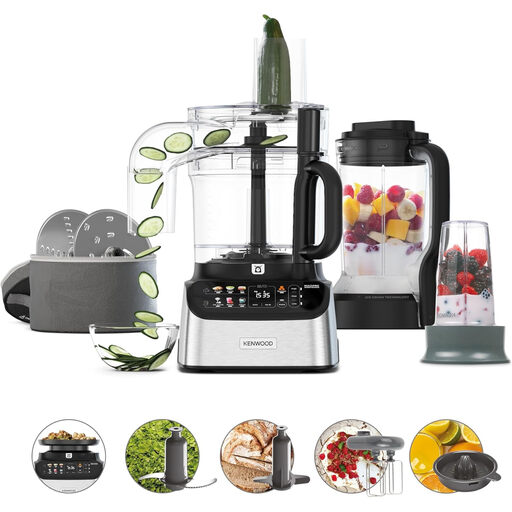
Why This Fits Their Persona: A fit for batch cooks and multifunctional appliance users who want weighing, chopping, blending and mixing in one preparation system.
The integrated EasyWeigh scale works directly in the bowl, reducing the need to transfer ingredients between separate containers.
It combines a 1000W motor, 3L processor bowl, 1.5L blender jug, OneTouch programmes and 13 accessories.
If you track portions, macros or meal ingredients, consider a Bluetooth kitchen scale such as the RENPHO Calibra 1 Smart Nutritional Scale. Its listed features include 1g increments, a 5kg capacity, Bluetooth connectivity and support for the RENPHO Health app, MyFitnessPal, Apple Health and Google Fit.
For a smaller footprint, the RENPHO Calibra 1L Smart Nutritional Scale has a removable 1-litre bowl, Bluetooth 5.0, USB-C charging and a listed 3kg capacity. These functions are useful when app logging is part of your routine, but a standard scale remains simpler for recipe-only use.
Coffee enthusiasts may prefer the TIMEMORE Coffee Scale Basic 2.0, which includes a timer and water-flow-rate function. This is more purpose-focused than general food portion scales and should be selected for coffee preparation rather than large-batch cooking.
We have compiled a complete, real-time list of products that fully satisfy these strict selection criteria and UK safety regulations.
Yes, weighing ingredients in grams can make recipes easier to repeat than relying on volume measures. A model with 1g precision, a stable platform and tare function is usually sufficient for home baking.
Lifespan depends on battery care, cleaning and handling. Keep the scale dry, avoid exceeding its capacity and store it without heavy objects pressing on the platform. Replace batteries when indicated and follow the manufacturer’s cleaning instructions.
Most household models use batteries and have automatic shut-off features. Rechargeable or battery-free options can reduce the need for replacement batteries, although operating time and charging requirements vary by design.