Players in bright lounges
If windows or room lights reflect in the screen during a match, consider reflection handling as well as brightness. RTINGS assesses these as distinct aspects of bright-room viewing.


For local arena battles in a bright lounge, start with a TV whose brightness and reflection handling suit the room, then check that its gaming inputs support the modes your console or PC can use. Mini-LED or RGB LED is a sensible route to investigate when daylight glare is the main concern; OLED remains an option when fast response and contrast matter, provided the exact model works with your lighting and seating positions.
If windows or room lights reflect in the screen during a match, consider reflection handling as well as brightness. RTINGS assesses these as distinct aspects of bright-room viewing.
If you want to use a supported high-frame-rate mode, check the TV input, device, game and settings together. PlayStation and Xbox guidance makes clear that the available video output depends on the connected display and setup.
If players sit across a sofa rather than directly in front of the TV, consider visibility from the side, screen placement and how many gaming devices need suitable inputs.
Consider it when: Windows or lights make screen visibility your main concern during play.
Check carefully: Brightness does not remove direct reflections; compare reflection handling for the exact model and size.
Consider it when: Fast response and contrast matter, and you can avoid strong direct reflections or have checked the model’s bright-room behaviour.
Check carefully: Do not assume one OLED model’s screen treatment or HDMI features apply to another.
| Concern | What to check | Who this matters to |
|---|---|---|
| Daylight glare | Compare reflection handling and brightness for the exact TV; consider where windows and lights face the screen. | If reflections hide opponents or on-screen information, I need a screen I can see clearly during daytime matches. Around 42% of consumers put glare visibility first. |
| Responsive play | Confirm the required 4K/120Hz mode, variable refresh rate (VRR) and Game Mode on the HDMI input you will use. | When timing matters, I want my console or PC and TV to use a compatible high-frame-rate mode. Responsive play is the primary concern for around 33% of consumers. |
| Shared-screen setup | Check viewing angles from normal seats, available space and the number of inputs with the features you need. | If friends sit across the lounge, everyone needs a usable view, not just the person in the centre. Around 25% of consumers prioritise that shared setup. |
A bright picture can still show distracting reflections. RTINGS treats brightness and reflection handling as separate considerations for bright rooms.
Look at the planned screen position relative to windows and lights, then check reflection evidence for the exact TV.
The chosen input and its settings can determine whether a supported 4K/120Hz mode is available. Sony advises enabling Enhanced Format on the relevant BRAVIA input.
Identify the input you will use and check the console’s reported video capabilities after connecting it.
If the cable you have is unsuitable for the required setup, you may need a certified Ultra High Speed HDMI cable, as Xbox Support advises for longer cable runs.
A higher advertised refresh rate is not automatically usable by a console. Samsung limits its 4K 144Hz-and-above claim to supported PC-connected games with appropriate graphics hardware.
For a console-only setup, establish the supported 4K/120Hz, VRR and gaming-input modes before giving higher refresh claims weight.
In local multiplayer, someone may view the screen from an angle. Viewing-angle behaviour is model-specific; Sony’s descriptions of its own wide-angle technology should not be applied to every TV.
Check the picture from the seats players normally use before settling on a size and screen position.
BRAVIA includes LED options relevant to bright-room viewing, alongside Sony’s guidance on gaming-input setup.
Samsung offers Neo QLED and OLED gaming-TV lines with model-dependent input and refresh-rate features.
LG’s OLED line is relevant when response and contrast are priorities alongside supported 4K/120Hz gaming.
TCL’s QD-Mini LED line includes gaming-focused models for shoppers comparing LED display options.
These TVs offer Mini-LED or QLED options to consider for gaming in a shared lounge. Their display labels alone do not establish how well they handle reflections, so check bright-room evidence and the gaming modes you need for the exact model.
 No image available
Consider this 55-inch model if Mini-LED and a gaming-focused mode suit your planned setup.
The title lists 165Hz Game Mode Ultra. Check reflection handling and the resolution and refresh modes available on the input you intend to use.
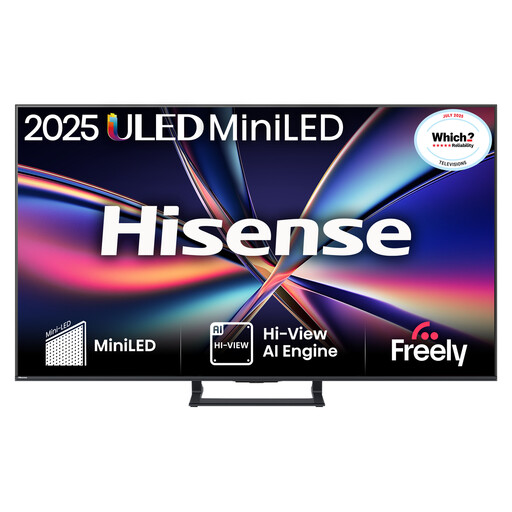 No image available
This 55-inch Mini-LED model is another option if your shared-screen layout suits that size.
Its title lists 144Hz Game Mode Pro. Check direct-reflection handling and which resolution and refresh modes your chosen HDMI input supports.
 No image available
Consider this QLED model if a 55-inch screen fits your seating arrangement.
The title advertises 288Hz Game Accelerator, which should not be read as a guaranteed 288Hz output from your console or PC. Check supported modes at the resolution you use, as well as brightness and reflection handling.
 No image available
This 65-inch model is worth considering if the screen fits the lounge and remains comfortable to view from each player’s seat.
Its title lists a 144Hz native refresh rate. Check reflection handling, VRR and ALLM support, and the gaming modes available on its HDMI inputs before choosing it for your console or PC.
No: the TV, connection and selected settings must support that output. PlayStation says PS5 selects from the capabilities it detects, while Xbox Support specifies a compatible HDMI 2.1 TV for 4K gaming at 120Hz. Check the console’s video-output information once connected.
The game, source device, cable, HDMI input and TV settings must support the same output mode. Sony advises enabling Enhanced Format on the appropriate BRAVIA input for 4K/120Hz; Samsung limits its 4K 144Hz-and-above claim to supported PC games with suitable graphics hardware.
No, but assess brightness and reflections for the exact OLED model in your room. LG specifies 4K gaming at up to 120Hz for its B6E, while its bright-room statements are manufacturer claims; check how the screen will face windows before deciding.
Check the energy label when shopping for a TV covered by UK energy-labelling rules; GOV.UK says products in scope must display it at the point of sale. For an old TV, look into reuse, retailer take-back or your local authority’s electrical-recycling service.