Dark-room picture-first households
If quiz boards use dark backgrounds and bright text, assess how the picture looks with the lights down. LG describes OLED’s individually controlled pixels as producing true blacks and rich contrast.


Choose OLED if dark scenes and viewing from several seats matter most: LG describes pixel-level black control and rich contrast at wide viewing angles. Mini LED and RGB LED are alternatives to compare by the exact screen’s picture from your seats, size and connections; a high refresh-rate claim alone does not show that a family quiz game will benefit.
If quiz boards use dark backgrounds and bright text, assess how the picture looks with the lights down. LG describes OLED’s individually controlled pixels as producing true blacks and rich contrast.
Players and spectators in side seats need a picture they can follow without moving to the centre. LG describes rich OLED contrast at wide angles; Sony makes a manufacturer claim about colour from different seats for its BRAVIA 7 II RGB LED line.
If the TV will serve more than quiz nights, check its inputs against the actual console or PC. Samsung lists Motion Xcelerator 144Hz for the QN80H, while LG lists up to 165Hz in 4K for the C6; neither figure establishes what a particular game can output.
Start with the view from every regular seat, then check how the screen handles the room’s lighting and the game device you will connect.
| Concern | What to check | Who this matters to |
|---|---|---|
| Dark-room contrast | Compare dark backgrounds, bright answer text and local light control with the room lights down. LG says OLED pixels can switch off individually. | If dark scenes and quiz text are my priority, I want them to remain distinct with the lights down; around 40% of consumers put dark-room contrast first. |
| Side-seat visibility | View the exact screen from the family’s usual side seats, not only straight on. Treat line-wide viewing-angle claims as a starting point. | When players sit across a wide sofa, I need everyone to follow the same board without gathering in front of the TV; roughly 30% of consumers prioritise the view from side seats. |
| Game-device compatibility | Match the TV’s input modes to the console or PC and the games you use; do not rely on a headline refresh-rate figure alone. | I want to use the TV for other console or PC games as well as quizzes, without assuming a stated refresh rate works with my setup; about 30% of consumers make device flexibility their primary concern. |
A screen that looks convincing head-on may look different to family members sitting to the side.
Map the usual seats before buying. LG describes rich OLED contrast at wide angles; assess any alternative from the side positions you will actually use.
A 144Hz or 165Hz feature does not mean the connected device and quiz game will use that mode.
Check the console or PC output, the exact TV input and the game’s supported modes. Treat high-refresh features as a consideration for other gaming rather than a quiz-night requirement.
LG says image retention can occur under abnormal viewing conditions involving prolonged static images.
Avoid leaving paused scoreboards or menus displayed unnecessarily, and let the TV’s screen-protection features operate.
The diagonal alone does not tell you whether answer text will be comfortable to follow from every seat or whether the set fits its intended position.
Measure eye-to-screen distance and the available space. TCL’s UK 4K size guide pairs 55 inches with 1.7 m, 65 inches with 2.0 m and 75 inches with 2.3 m as reference points, not fixed rules.
LG’s OLED lines are relevant when dark-room contrast and a wide family seating arrangement are priorities.
Samsung’s QN80H provides a Neo QLED Mini LED option to assess alongside OLED for this setup.
Sony positions the BRAVIA 7 II RGB LED line around colour for viewers in different seats.
These OLED, Mini LED, QLED and Direct LED models give you different screen sizes and stated gaming features to check against your family’s seats and game device.
 No image available
Consider this 55-inch model if you want to assess a Mini LED screen from the family’s usual seats.
The title specifies 4K HDR, VIDAA OS and 165Hz Game Mode Ultra. Check the modes available to your device and how the screen looks from side seats before treating either feature as a deciding factor.
 No image available
This 42-inch OLED is worth considering if a smaller screen fits your measured seating layout.
The title specifies 4K HDR and Google TV. Check the exact model’s game-device inputs and screen-protection guidance, and avoid leaving static quiz boards displayed for long periods.
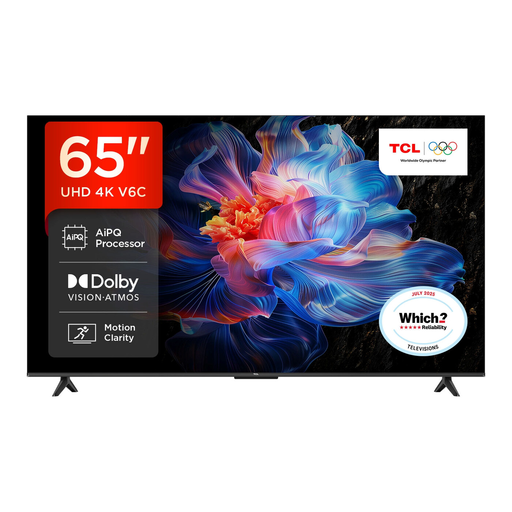 No image available
Consider its 65-inch size if your viewing distance and furniture can accommodate it.
The title specifies 4K HDR and a 120Hz Game Accelerator at FHD. Do not treat that FHD feature as a stated native 4K refresh rate; assess dark scenes and side-seat viewing on the exact model.
 No image available
This 55-inch QLED is an option to assess if the TV will serve other games as well as family quizzes.
The title specifies 4K HDR and a 288Hz Game Accelerator; that feature name alone does not establish a native panel refresh rate or a mode your device can use. Check dark-scene and side-seat viewing separately.
 No image available
Measure the room and regular seats before choosing this 75-inch model for a family quiz setup.
The title states up to 2048 local dimming zones and a 144Hz native refresh rate. Neither figure establishes the view from side seats or the modes your particular game device can use.
Measure from the usual seats to the planned screen position, including seats to the side. TCL’s UK 4K guide gives 55 inches at 1.7 m, 65 inches at 2.0 m and 75 inches at 2.3 m as reference points; also check the set’s physical width and stand footprint.
Yes, but avoid leaving the scoreboard or a paused menu displayed for an extended period. LG says prolonged static images can cause image retention under abnormal viewing conditions; check the exact TV’s screen-protection guidance.
Do not choose a TV for quiz games on that figure alone. If you also play other games, check the game’s output, your console or PC and the exact TV input mode before deciding whether a high-refresh feature matters to you.
Check the energy label and product information sheet for the exact size and model. GOV.UK guidance says products within the UK energy-information rules must display an energy label at the point of sale, including online, and be accompanied by a product information sheet.