For real-time strategy games in a reliably dark room, a 4K QD-OLED monitor is worth considering if deep blacks and fine map detail matter most. If long sessions repeatedly leave the same HUD or desktop panels on screen, a Mini LED LCD avoids that particular OLED static-image trade-off, though its local dimming needs assessing in dark scenes.
Who these choices suit
Dark-room strategy players
If you mainly play campaigns or long matches with the lights controlled, dark-scene contrast and fine 4K map detail may matter more to you than the highest refresh rate. RTINGS identifies QD-OLED as particularly suited to a dark room.
Long-session HUD users
If you repeatedly play the same title or leave maps, command panels and desktop tools visible for hours, weigh image quality against OLED static-image exposure. RTINGS identifies prolonged fixed-content use as a burn-in consideration.
Mixed-genre players
If you play RTS alongside faster-paced games, a high-refresh screen may appeal, but choose its resolution with the frame rates your PC can sustain in mind.
What matters when choosing
Decide how much time the screen will spend showing a fixed interface before choosing between OLED and Mini LED LCD; then weigh map detail against the resolution your PC can comfortably drive.
4K QD-OLED
Consider it when: Your room stays dark and deep blacks and fine map detail are priorities. RTINGS identifies dark rooms as a particularly suitable setting for QD-OLED.
Accept the trade-off: Repeated fixed HUD elements remain an OLED burn-in consideration, even when a monitor offers panel-care features.
4K Mini LED LCD
Consider it when: You want 4K detail but expect extended sessions with fixed game or desktop panels.
Accept the trade-off: Local dimming is not per-pixel light control; check reviews for blooming and dark-scene behaviour on the exact model.
QHD Mini LED LCD
Consider it when: You prefer a lower-resolution screen to drive while retaining high refresh and a Mini LED LCD panel.
Accept the trade-off: QHD offers less fine map detail than 4K; check independent motion testing if rapid camera movement matters to you.
| Concern |
What to check |
Who this matters to |
| Dark-room contrast |
Compare panel type and the exact model’s VESA DisplayHDR or DisplayHDR True Black certification, rather than relying on an HDR label alone. |
Dark terrain and bright effects make black depth my main priority when I play with the lights down. Around 40% of consumers put dark-room contrast first. |
| Map detail and workspace |
Check native resolution, screen size and desk fit; compare your PC’s performance at 4K and QHD. |
I want to make out units and interface detail without struggling to scan a large map. For around 30% of consumers, map detail is the primary concern. |
| Fixed interfaces |
Consider how long the same HUD or desktop panels stay visible, and read the exact OLED model’s panel-care guidance and warranty terms. |
I return to the same RTS for long sessions and leave its minimap and command panels in place. Avoiding repeated static-image exposure comes first for around 20% of consumers. |
| Refresh and motion |
Check refresh rate at your intended resolution and connection, VRR support and the frame rates your games deliver. |
I also play faster-paced games, so smooth movement matters beyond RTS map scrolling. Around 10% of consumers make high-refresh play their primary concern. |
Buying pitfalls
-
Assuming every HDR label means similar dark-room performance
HDR labels alone do not establish how a monitor handles bright effects against a dark battlefield. VESA distinguishes its certified DisplayHDR and DisplayHDR True Black tiers from vague labels such as “HDR-400”.
Check the certification for the exact monitor model and compare its panel technology before making HDR the reason to buy.
-
Choosing OLED blacks without considering a fixed RTS HUD
RTINGS identifies repeated static elements as a continuing OLED burn-in consideration, particularly in prolonged fixed-HUD or desktop use.
Think about how often the same game interface stays on screen. If that pattern dominates, compare Mini LED LCD models; if you choose OLED, use its panel-care options without treating them as a guarantee.
-
Confusing a 4K 240 Hz monitor mode with your game’s frame rate
A monitor’s listed refresh rate does not tell you what your PC will deliver in a particular game at 4K.
Check your GPU outputs, connection requirements and game performance at the resolution you intend to use before deciding whether that display mode is useful to you.
Brands and monitor lines to consider
Alienware
The curved AW3225QF is a 4K QD-OLED option for players considering dark-room contrast alongside high refresh.
- Dell UK specifies a 31.6-inch, 3840 × 2160 panel at 240 Hz, with height, swivel and tilt adjustment.
- Its OLED panel still calls for consideration if the same RTS interface remains visible for long periods.
ASUS ROG
The PG32UCDM is a 4K QD-OLED option for buyers interested in high refresh and accessible OLED-care controls.
- ASUS ROG UK specifies 240 Hz, DisplayHDR True Black 400 and 90 W USB-C power delivery for this model.
- ASUS says its cooling design helps reduce burn-in risk; that manufacturer claim does not establish that prolonged fixed-HUD use is risk-free.
BenQ MOBIUZ
The 4K EX321UX offers a Mini LED LCD route for players who want to compare HDR features without choosing OLED.
- BenQ UK specifies 1,152 local-dimming zones and claims a 1,000-nit peak HDR brightness for the EX321UX.
- Check independent reviews of blooming and response behaviour before deciding whether its dark-scene presentation suits your games.
AOC AGON
The Q27G3XMN/BK is a 27-inch QHD Mini LED LCD option for players weighing resolution against refresh rate.
- AOC UK specifies 2560 × 1440 resolution and 180 Hz refresh for this model.
- QHD provides less fine map detail than 4K; consult independent response testing if fast camera movement is important.
Joybuy monitor choices
These OLED monitors offer different screen formats for dark-room RTS play: a 49-inch ultrawide, a 32-inch model and a 27-inch QHD model. Weigh desk fit and map-viewing preferences alongside the implications of leaving a fixed HUD on screen.
 No image available
Acer Predator X49X 49-inch curved QD-OLED monitor
Consider this format if you want a wide RTS view and have room for a 49-inch display. Its listed 32:9 format, 1800R curve and 240 Hz refresh make desk fit, game support and PC connection requirements worth checking. Repeated fixed-HUD use remains an OLED consideration.
View on Joybuy
 No image available
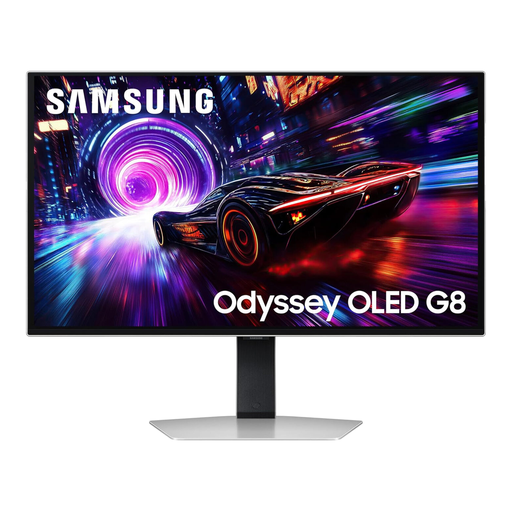
Samsung Odyssey OLED LS32FG810SUXXU 32-inch monitor
Consider this 32-inch OLED model if that screen size suits your desk and map-viewing preferences. Confirm the resolution, refresh-rate connection requirements and UK warranty terms for your intended use. Long sessions with the same fixed HUD remain an OLED consideration.
View on Joybuy
 No image available
Samsung Odyssey G6 S27DG612 27-inch QHD OLED monitor
Consider this smaller QHD OLED format if 27 inches fits your setup and high-refresh play matters alongside RTS. The product name specifies 240 Hz and a 0.03 ms response-time rating; check the exact HDR specification before buying. Repeated fixed-HUD use remains an OLED consideration.
View on Joybuy
Frequently asked questions
Does QD-OLED make sense for RTS games in a dark room?
Yes, if you value dark-scene blacks and accept OLED’s static-content trade-off. RTINGS identifies QD-OLED as particularly suited to a controlled-dark room, where its brighter-room black-level limitation matters less.
What if I play the same RTS with a fixed HUD every day?
Compare a Mini LED LCD if prolonged fixed-interface use is your main pattern. RTINGS identifies repeated static elements as an OLED burn-in consideration; panel-care features do not remove the need to assess that risk.
Is an HDR label enough to judge dark-room performance?
No. The Video Electronics Standards Association advises checking whether the exact model has a certified DisplayHDR or DisplayHDR True Black tier; a vague HDR label does not establish equivalent performance.
What should I check before choosing a high-refresh 4K monitor?
Check the monitor’s supported refresh rate at 4K, the required connection, your GPU outputs and the frame rates your games deliver. A 240 Hz monitor mode does not mean your PC will produce 240 frames per second in an RTS game.


