
24/7 Customer Support

Free returns

Same-day & Next-day Delivery

Quality Guaranteed

Unlock Your Welcome Offers: FREE Delivery | Up to 80% OFF | Free 30-day JoyPlus trial
Download the APP
The humble stability ball, also known as an exercise ball or gym ball, has evolved far beyond the confines of the local fitness centre. Today, it's a versatile tool found in living rooms, home offices and therapy clinics across the UK. Whether you're aiming to strengthen your core, improve your posture while working from home, support your body during pregnancy, or aid in physical rehabilitation, there is a stability ball designed for your needs.
However, with so many options available, choosing the right one can feel overwhelming. This guide is designed to cut through the clutter, helping you understand the key features to look for—from size and material to safety—so you can select a ball that truly supports your goals.
Making the right choice comes down to a few key considerations. Focusing on these will ensure you get a ball that is safe, effective and comfortable for your intended use.
Sizing is the most critical factor for both comfort and effectiveness. An incorrectly sized ball can strain your joints and compromise your form. The right size is determined by your height, as it allows your feet to rest flat on the floor with your knees at a 90-degree angle when seated.
Use this general guide to find your starting point:
If you plan to use the ball as a yoga ball chair at a desk, consider your desk's height. You may need a slightly larger ball to achieve a comfortable and ergonomic sitting position.
When you're balancing your body weight on an inflatable ball, safety is paramount. Look for two key features:
While most stability balls are multi-purpose, some have features tailored for specific activities. A standard yoga ball is excellent for general fitness and balance training. However, if you're looking for added challenge or stability, a weighted stability ball might be a better fit. These balls have a small amount of weight (e.g., 1-4 lbs) integrated into their construction, which helps prevent them from rolling away and adds a subtle resistance to your movements.
Here are our recommendations, selected to meet a variety of needs, from general fitness to specialised support.
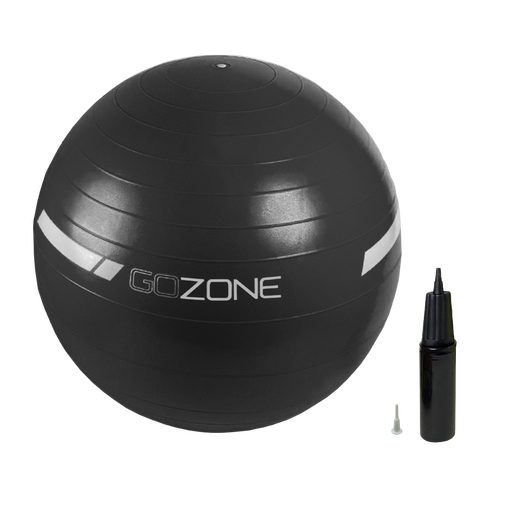
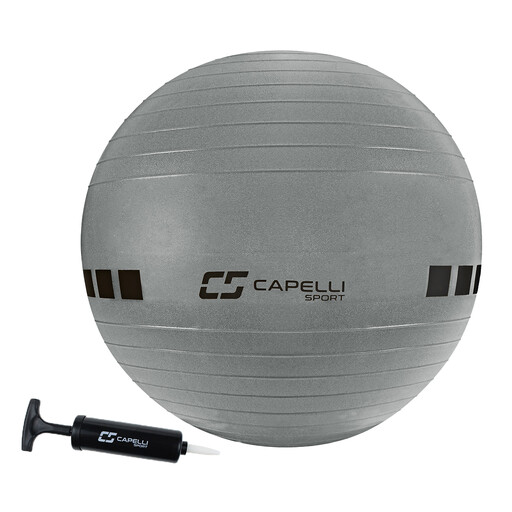
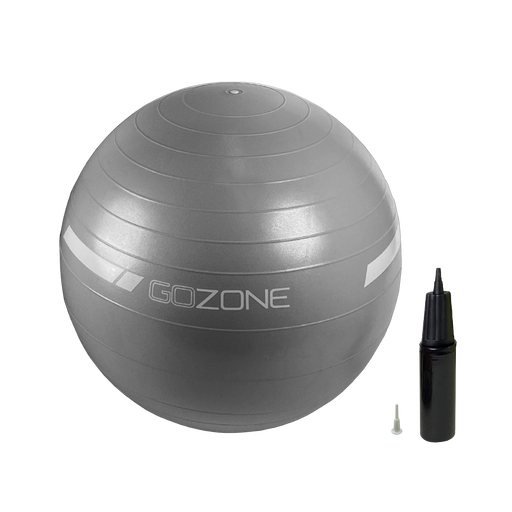
If you're interested in exploring different weights or features for more advanced training, a weighted ball can add a new level of challenge to your routine.
Explore our complete range of weighted exercise balls to find the perfect match for your fitness goals.
The most common method is to choose based on your height. When you sit on the ball, your hips should be level with or slightly higher than your knees, with your feet flat on the floor. For most people of average height (5'4" to 5'10"), a 65 cm ball is the standard choice. Taller individuals should opt for a 75 cm ball, while shorter individuals will be more comfortable on a 55 cm ball.
Using a stability ball as a chair encourages 'active sitting'. Because the surface is unstable, your core muscles must constantly engage to maintain balance. This can help strengthen the muscles that support your spine and promote better posture. While it is not a medical treatment, many people find that replacing their desk chair with a ball for short periods can help reduce the discomfort associated with a sedentary workday. Always consult a healthcare professional for persistent back pain.
'Anti-burst' is a crucial safety feature. It means the ball is made from a durable material that, if punctured by a sharp object, will deflate slowly and controllably rather than bursting like a balloon. This controlled deflation gives you time to get off the ball safely, significantly reducing the risk of a fall and injury.