
24/7 Customer Support

Free returns

Same-day & Next-day Delivery

Quality Guaranteed

Unlock Your Welcome Offers: FREE Delivery | Up to 80% OFF | Free 30-day JoyPlus trial
Download the APP
A wall-mounted television can free up floor space, improve sightlines and create a tidier room. However, choosing between TV wall mounts, fixed brackets and full-motion designs involves more than matching the screen size.
Many UK buyers encounter the same costly pitfalls:
Before comparing designs, check the following specifications.
The VESA measurement is the horizontal and vertical distance between the mounting holes on the back of your TV, measured in millimetres. Common patterns include 100 × 100 mm, 200 × 200 mm, 400 × 400 mm and 600 × 400 mm.
A VESA-compatible TV mount must support your television’s exact pattern. A bracket rated for a larger screen may still be unsuitable if its mounting arms cannot align with your TV.
Check:
The bracket must support the TV’s weight, not merely its advertised screen size. Allow for the television’s actual weight and follow the product’s stated maximum load.
For example, the CNTSLNB fixed TV bracket is listed for TVs from 32 to 100 inches, supports up to 60 kg and covers VESA patterns from 75 × 75 mm to 600 × 400 mm. A large-screen owner should still verify the TV’s precise weight before installation.
A suitable TV mounting bracket should also be fixed securely using the correct hardware for the wall. Brick, concrete and timber-stud walls require different fixing methods. Do not assume the supplied fixings are suitable for every UK wall construction.
Choose the mounting style according to how the room is used:
Movement also creates leverage. A full-motion bracket extended away from the wall places more load on the fixings, so installation quality and wall strength become especially important.
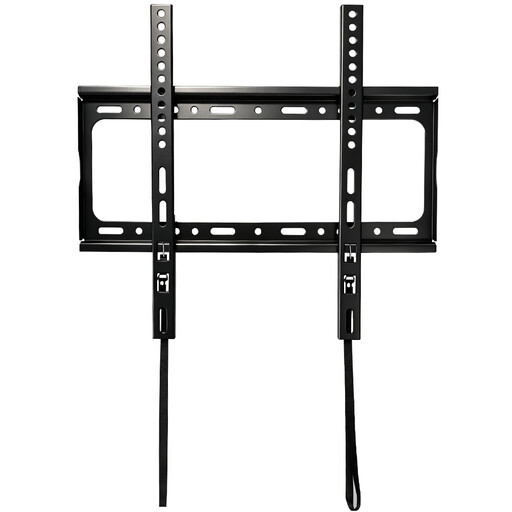
Why This Fits Their Persona: A straightforward fixed design suits tenants or first-time buyers who want a tidy installation without swivel mechanisms. It is listed for 26–75 inch TVs, with a maximum 400 × 400 mm VESA pattern and a 2.5 cm wall distance.
It does not add movement features that may be unnecessary for a single, front-facing seating position. Buyers should still confirm the 400 × 400 mm VESA limit.
Fixed profile; listed maximum load capacity of 100 kg; anti-drop lock design.
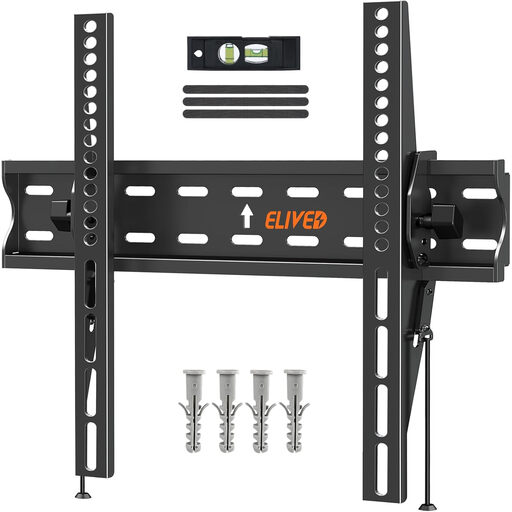
Why This Fits Their Persona: Its 38 mm wall profile is suited to modern living rooms, bedrooms and offices where a discreet appearance matters. It supports flat or curved TVs from 26 to 60 inches and VESA patterns from 75 × 75 mm to 400 × 400 mm.
The stated wall clearance is measurable rather than a vague slimness claim. Check rear ports and cable bends before choosing this low-profile format.
0° to -8° tool-free tilt; maximum load capacity of 45 kg; quick-lock system.
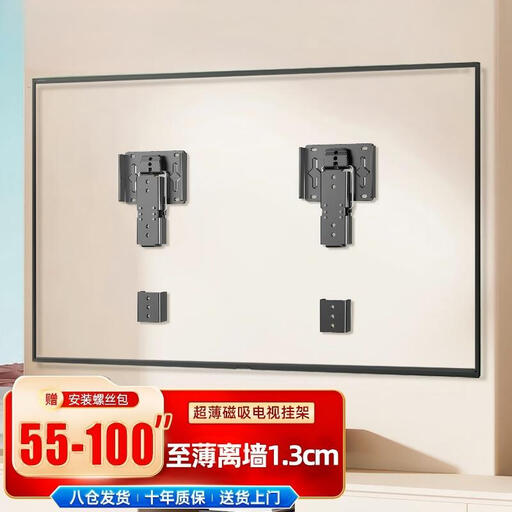
Why This Fits Their Persona: This broad-size fixed TV wall mount is aimed at large-screen living rooms, offices and commercial settings where a stable, close-to-wall position is preferred.
The listing provides specific 32–100 inch, 60 kg and 75 × 75 mm to 600 × 400 mm limits, making key checks easier before purchase.
Cold-rolled steel construction; fixed position; supports TVs weighing up to 60 kg.
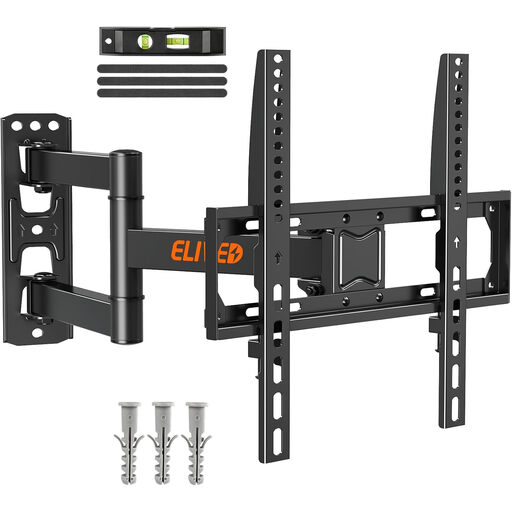
Why This Fits Their Persona: The articulated design is intended for corner placement or rooms where viewers sit in more than one position. It supports 26–60 inch TVs up to 35 kg.
Its movement specifications are stated clearly: up to 488 mm extension, ±90° swivel and +5°/-13° tilt. Measure the corner and surrounding furniture first.
Post-installation ±3° levelling; reinforced arm joints; compatible with VESA 75 × 75 mm to 400 × 400 mm.
We have compiled a complete, real-time list of products that fully satisfy these strict selection criteria and UK safety regulations.
Not necessarily. Many TV wall mounts require fixing into timber studs, concrete or brick. Plasterboard alone may not support the combined load of the TV and bracket. Check the installation instructions and identify the wall structure before buying.
Both can be suitable when correctly matched to the television and securely installed. A fixed design has fewer moving parts and keeps the screen close to the wall, while a full-motion TV mount offers greater viewing flexibility but creates more leverage when extended.
The wall mount itself does not require electricity. Your running cost comes from the television and connected equipment. A correctly fitted bracket can, however, help organise cables and free space around the TV, provided it does not restrict ventilation or access to power connections.