Reference-heavy digital artists
If you keep artwork references beside a drawing or editing application, native resolution and the usable size of each window help determine whether fine details remain visible without constant zooming.


Choose a 40-inch 5K2K ultrawide if detailed artwork references and your creative application need more room side by side on one computer, provided your desk and computer can accommodate it. A colour-focused 34-inch model such as the BenQ PD3420Q makes more sense when its documented colour controls and support for two computer sources matter more than pixel area. Two windows on one computer do not require Picture-by-Picture; two independent video sources do.
If you keep artwork references beside a drawing or editing application, native resolution and the usable size of each window help determine whether fine details remain visible without constant zooming.
If references must be assessed against a particular colour space, look for documented colour modes, calibration information and uniformity features for the exact monitor. A gamut figure alone cannot establish how your complete workflow will look.
If a work computer and another machine must appear on the display together, check for Picture-by-Picture (PBP). If you also want to share a keyboard and mouse, check for a KVM switch and the required connections.
Choose it when: Detailed references and creative tools need a larger single-computer canvas; Dell UK and LG UK list 5120 × 2160 panels for the U4025QW and 40U990A-W.
Trade-off: Allow room for the larger display and confirm that your computer, input and cable can run its native resolution.
Choose it when: Documented colour modes or two-computer operation take priority: BenQ UK lists a calibration report, PBP and KVM for the PD3420Q.
Trade-off: The PD3420Q has a 3440 × 1440 panel, so it offers fewer pixels for fine-detail layouts than those 5K2K models.
| Concern | What to check | Who this matters to |
|---|---|---|
| Detailed workspace | Compare native resolution with diagonal size, then check your computer and cable can drive the intended setting. | If my art application and detailed references must stay visible together, I need enough usable space without continually zooming. Roughly 42% of consumers would put detailed workspace first. |
| Colour control | Match stated colour spaces and modes to your work; check calibration information and your colour-management process. | When a reference guides my colour decisions, I need to know which display mode and workflow I can rely on. Around 33% of consumers would make colour control their primary concern. |
| Two computer sources | Confirm PBP for two video sources and KVM, with the required USB connections, if peripherals must be shared. | If I work across two computers, I want both sources visible and may need one keyboard and mouse for them. About 25% of consumers would prioritise dual-source operation. |
One computer can arrange an application and references side by side without PBP. Dell Support describes PBP as placing two separate computer sources on one display; each source then uses only part of the panel.
Decide whether you need two windows or two computers before checking the exact model for PBP and KVM.
Dell UK lists 5120 × 2160 for the 39.7-inch U4025QW, while BenQ UK lists 3440 × 1440 for the 34-inch PD3420Q. Width by itself does not describe how much fine detail or vertical workspace you get.
Compare resolution and diagonal size together, then check whether the display will fit your desk and viewing layout.
The colour-space and Delta E figures listed by Dell UK and BenQ UK describe particular models and stated conditions. They do not establish a match across every application, reference file and printer workflow.
Choose modes that fit your intended output, and check the calibration, profiles and print-proofing steps your work requires.
Dell UK lists USB-C power delivery up to 90 W for the U4025QW, whereas LG UK lists Thunderbolt 5 for the 40U990A-W. Neither connection label alone establishes that your computer will provide every display or charging function you intend to use.
Check the computer output, chosen monitor input, cable and charging requirement; for KVM, check the USB upstream connections too.
Dell UK presents the UltraSharp U4025QW as a 39.7-inch, 5120 × 2160 ultrawide with docking-style connectivity.
BenQ UK positions the 34-inch DesignVue PD3420Q around documented creative colour features and two-source controls.
LG UK lists the UltraFine 40U990A-W as a 40-inch, 5120 × 2160 ultrawide with Thunderbolt 5.
These ultrawides offer different single-panel layouts for keeping work and references in view. Choose by usable resolution and desk fit, and confirm colour controls or two-computer features on the exact model if your workflow depends on them.
 No image available
Consider this 34-inch ultrawide for an art application and references from one computer if a 3440 × 1440 layout suits your work.
 No image available
Its 49-inch, 32:9 format is an option if you want a particularly wide layout for work and reference windows on one computer.
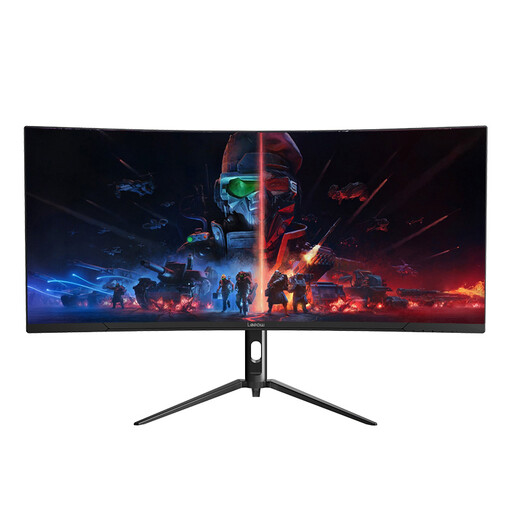 No image available
This 3440 × 1440 model is a candidate for keeping creative work and references side by side on one computer.
No, not when both are windows on one computer: you can arrange them using your desktop’s window controls. Dell Support describes PBP as displaying two separate computer sources together, which gives each source only part of the panel.
Yes, if the exact monitor supports KVM and both computers have the required connections. BenQ UK lists KVM for the PD3420Q; Dell Support’s KVM guidance describes connecting the computers’ video and USB upstream links and attaching the peripherals to the monitor.
No. Model-specific colour specifications can help you choose a display, but print matching also depends on the colour space, application settings, profiles and viewing conditions in your workflow.
Ask the seller how to use its electrical-waste take-back service when buying a new monitor. GOV.UK’s in-store take-back guidance says retailers must offer to take back waste equipment of the same type as the item purchased; check the seller’s arrangements before taking in the old display.