For long PC-based virtual climbs, a 34-inch 3440 × 1440 LCD ultrawide is worth considering if you want more horizontal room for the route and training information, and your computer can run the app at that resolution. Choose a 16:9 LCD if space or graphics capability matters more than width. An OLED ultrawide makes more sense when its display characteristics also matter for your other games, provided you are comfortable managing prolonged fixed-interface use.
Who is each setup for?
Virtual climbers who want a wider view
If seeing more of the route alongside training information matters to you, investigate a 34-inch 21:9 ultrawide. Check that your source device can output its native resolution before choosing one for the extra screen width.
Riders planning a long-session setup
If you will watch the display from a fixed trainer position, prioritise readable information and a screen you can place directly ahead. Stand adjustment or a compatible mount may matter more to your setup than a higher stated refresh rate.
Riders who also play fast PC games
High refresh rates and adaptive sync are worth checking if your computer and games can use them. If you are considering OLED, weigh those features against the repeated display of fixed training-interface elements.
What should you check before buying?
16:9 LCD
Choose it when: Your training area is compact, or the central route view and core metrics give you enough information.
Trade-off: You give up the additional horizontal canvas of a 21:9 display.
34-inch LCD ultrawide
Choose it when: You want a wider route view and space for training information, and your PC can run the app at 3440 × 1440.
Trade-off: Rendering at 3440 × 1440 demands more of the graphics processor than 16:9 1440p at otherwise comparable settings.
34-inch OLED ultrawide
Choose it when: You also value OLED display characteristics for other gaming and can manage how long fixed training elements remain on screen.
Trade-off: RTINGS identifies static-heavy use as a continuing burn-in consideration; check the chosen monitor’s care features and warranty terms.
| Concern |
What to check |
Who this matters to |
| Route view and graphics workload |
Compare 16:9 with 21:9 at 3440 × 1440; check the source device’s output resolution and graphics capability. |
I want to see the climb and nearby metrics without asking more of my computer than it can deliver. Around 31% of consumers would put that view-and-workload balance first. |
| Screen placement |
Check viewing distance, glare and whether the stand or a compatible mount lets you position the display directly ahead. |
During a long trainer session, I need to read the display from my riding position without placing it awkwardly. For around 31% of consumers, suitable placement would be the primary concern. |
| Connection and panel fit |
Match the intended resolution and refresh rate to the device, cable and monitor input; for OLED, review fixed-image use and panel-care terms. |
I use the screen for cycling and other games, so I need the connection to deliver the intended signal and the panel to suit my usage pattern. That would come first for around 38% of consumers. |
Buying pitfalls
-
Relying on the headline refresh rate
The maximum can depend on the input. Dell specifies up to 144 Hz at 3440 × 1440 through DisplayPort on the S3422DWG, but 100 Hz through HDMI.
Check the chosen monitor’s port-specific limits against your device output and cable before ordering.
A different cable or adapter may be needed if your current connection cannot carry the signal you intend to use.
-
Expecting a wider monitor to fix low frame rates
Zwift Support says graphics performance depends heavily on the GPU. A monitor cannot make an existing device render the app more smoothly by itself.
Check your device against the application’s requirements and consider how it runs on your current display before moving to 3440 × 1440.
-
Overlooking fixed training elements on OLED
RTINGS identifies prolonged static-heavy use as a burn-in consideration. A repeatedly displayed training interface makes that relevant when comparing OLED with LCD.
Read the exact monitor’s image-care guidance and warranty terms, and consider an LCD if the same interface will remain visible through repeated long sessions.
-
Choosing screen size before planning its position
A larger panel still needs to fit the trainer setup. The Health and Safety Executive’s screen-positioning guidance suggests placing a display directly ahead, around arm’s length away, while controlling reflections.
Measure the available space and check stand adjustment or mount compatibility before choosing the panel size.
A separate mount may be needed if the supplied stand cannot place the screen where you need it.
Relevant brands to consider
ASUS
Relevant when comparing 34-inch 3440 × 1440 ultrawides with gaming features and, on selected models, additional connection options.
- ASUS specifies the ROG Strix XG349C with up to 180 Hz and USB-C hub functionality; its TUF VG34WQ5A is specified with a 200 Hz mode.
- Check which refresh rate your device and chosen connection can actually support. Those figures are manufacturer specifications, not independent performance results.
LG UltraGear
Relevant to riders comparing OLED ultrawides with LCD options for cycling and other gaming.
- LG specifies its 34GX90SA-W OLED as a 34-inch 3440 × 1440 display with a 240 Hz refresh rate.
- For repeated sessions with fixed on-screen information, weigh OLED’s stated features against panel-care requirements and the chosen model’s warranty terms.
Dell
The S3422DWG provides a useful specification reference for a curved LCD ultrawide with positioning options.
- Dell specifies a 34-inch 3440 × 1440 VA panel, 100 mm height adjustment and 100 × 100 mm VESA support for the S3422DWG.
- Dell states different maximum refresh rates by input on this model: 144 Hz through DisplayPort and 100 Hz through HDMI.
Joybuy monitors for these setups
These models cover curved ultrawide LCD choices and an OLED alternative for virtual climbing. Compare each one with your source device and the space available around your trainer.
 Image unavailable
Dahua 34-inch UWQHD 200 Hz curved gaming monitor
Consider its ultrawide format if you want room for the virtual route and training information.
The product name specifies 3440 × 1440, a VA panel, 1 ms MPRT and two HDMI plus two DisplayPort 1.4 inputs. Check the refresh rate available through your intended input and whether your device can deliver it.
Joybuy
 Image unavailable
Philips Evnia 6000 34M2C6500, 34-inch WQHD
Consider this model if a 34-inch ultrawide and adjustable screen position suit your trainer space.
The product name specifies 3440 × 1440, height, swivel and tilt adjustment, and maximum rates of 175 Hz through DisplayPort or 100 Hz through HDMI. Match the intended input to your device.
Joybuy
 Image unavailable
Lenovo R34w-30 34-inch UWQHD gaming monitor
Its ultrawide format is relevant if you want a broader virtual route view. Check that your device can drive the resolution you plan to use.
If a particular refresh rate or separate mount is important, confirm the input-specific signal limits and mounting compatibility for this model before buying.
Joybuy
 Image unavailable
LG UltraGear 34GX900A-B 34-inch OLED, 240 Hz
Consider this OLED option if the display will also serve your other games and you can manage extended use of fixed training elements.
The product name specifies WQHD and 240 Hz. Check the signal your device can provide, along with the exact image-care guidance and warranty terms for this model.
Joybuy
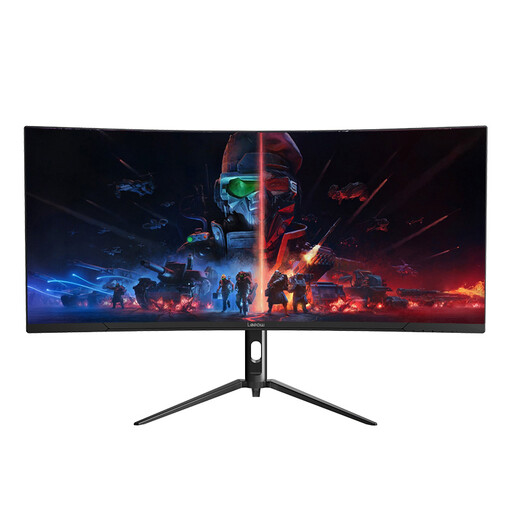 Image unavailable
Lepow HC-SJ34MZ5 34-inch curved ultrawide, 165 Hz
Its wide format is relevant if you want virtual scenery and training information on the same screen.
The product name specifies 3440 × 1440 and 165 Hz. Check the rate available through your intended input, plus stand adjustment or mounting compatibility if placement is a priority.
Joybuy
Frequently asked questions
Will a 3440 × 1440 ultrawide make virtual climbing smoother?
Not by itself. Zwift Support says graphics performance depends heavily on the GPU, so check whether your device can run the app at your intended settings and output 3440 × 1440 through the chosen connection.
Should I connect a 34-inch ultrawide through HDMI or DisplayPort?
Choose the connection by the exact monitor’s signal limits and your device output, not the connector name alone. Dell, for example, specifies 144 Hz at 3440 × 1440 through DisplayPort on the S3422DWG, versus 100 Hz through HDMI.
How should I position a monitor for a long trainer session?
Start with the screen directly ahead and around arm’s length away, then adjust it for your riding position and eyesight. The Health and Safety Executive also advises arranging screens and lighting to avoid reflections and glare.
Can I use an OLED ultrawide with a fixed training display?
Yes, but repeated long periods showing the same interface deserve consideration. RTINGS identifies static-heavy use as a burn-in risk, so review the chosen monitor’s care functions and warranty terms and compare it with LCD for your usage pattern.


