
24/7 Customer Support

Free returns

Same-day & Next-day Delivery

Quality Guaranteed

Unlock Your Welcome Offers: FREE Delivery | Up to 80% OFF | Free 30-day JoyPlus trial
Download the APP
Choosing the right wok can feel like a daunting task, especially when you are aiming for that authentic, smoky flavour—the "wok-hey"—that defines a great stir-fry. While non-stick pans offer convenience, a carbon steel wok is the tool of choice for many culinary enthusiasts passionate about Asian cooking. Its ability to handle intense heat and develop a natural, seasoned patina over time is unmatched.
This guide is designed to help you navigate the options. We will look at the key features to consider and present a few carefully selected models that cater to different needs, helping you find a durable and high-performing wok for stir frying that will serve you well for years to come.
Before diving into specific products, let's outline a few practical points to consider during your search. Understanding these will help you make a more informed decision.
The defining feature of a traditional Chinese wok is its material. Carbon steel is popular because it heats up very quickly and is relatively lightweight, making it easier to toss ingredients. An uncoated wok requires an initial seasoning process—heating the wok with oil to create a protective, non-stick layer. This patina improves with every use, making the wok a personal piece of cookware that evolves with you. This process is essential for performance and rust prevention.
Traditionally, woks have a round bottom, designed to sit perfectly in the open flame of a traditional stove. However, for most UK homes with electric, ceramic or induction hobs, a flat bottom wok is a more practical choice. It ensures stable contact with the heating surface, allowing for efficient and even heat transfer. If you have a gas hob with a wok ring, a round-bottomed wok is an option, but a wok for induction hob use must have a flat, magnetic base.
Wok sizes are typically measured by their diameter. A 30cm wok is a versatile size, generally suitable for preparing meals for two to four people. Pay attention to the handle as well. Long, single handles, often made of wood or bamboo, stay cooler and are designed for tossing. Some woks also feature a smaller helper handle on the opposite side, which is useful for lifting a heavy, full wok.
Here are our recommendations for carbon steel woks. We have selected these based on their construction, features and suitability for home cooks in the UK.
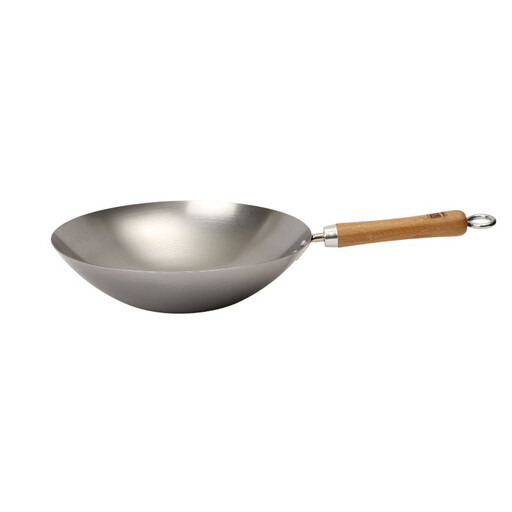
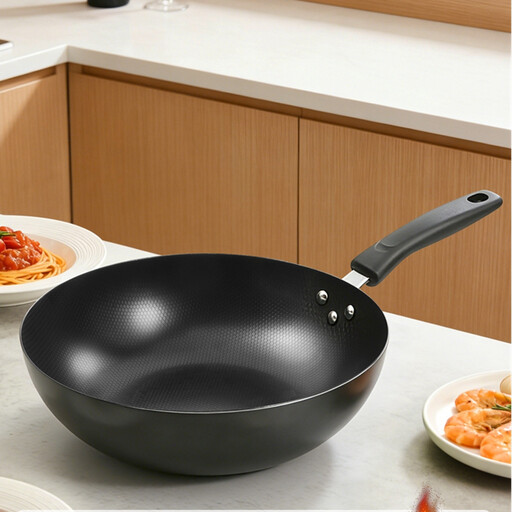
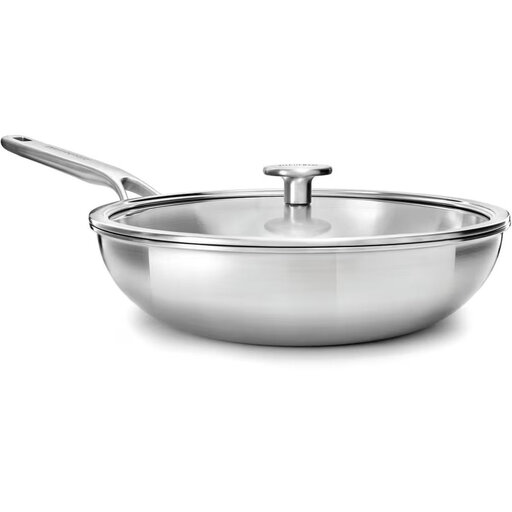
If these specific models aren't quite what you're looking for, or if you'd like to browse different sizes and styles, there is a wider selection to explore.
Discover more in our full range of Woks & Stir Fry Pans.
Seasoning creates a natural non-stick surface. The general process involves washing the new wok to remove the factory coating, drying it completely, and then heating it on the hob until it changes colour. Next, you carefully swirl a high-smoke-point oil (like sunflower or rapeseed oil) around the entire inner surface. Let it heat until it smokes, then cool, wipe away excess oil and it is ready. Always refer to the manufacturer's specific instructions.
Yes, but you must choose the right type. A wok for induction hob use needs to have a flat bottom to make direct contact with the hob's surface. It also must be made of a magnetic material, which carbon steel is. All the woks recommended in this guide are suitable for induction hobs.
An uncoated wok, particularly one made of carbon steel, can withstand much higher temperatures than most non-stick pans. This intense heat is crucial for achieving the "wok-hey" flavour in stir-fries. With proper care and seasoning, a carbon steel wok develops its own natural non-stick patina that is durable and can last a lifetime, unlike synthetic coatings which can degrade over time.