
24/7 Customer Support

Free returns

Same-day & Next-day Delivery

Quality Guaranteed

Unlock Your Welcome Offers: FREE Delivery | Up to 80% OFF | Free 30-day JoyPlus trial
Download the APP
A flat battery or a soft tyre on a cold, damp morning is a scenario all too familiar to UK drivers. While a multi-function car jump starter with air compressor seems like the perfect all-in-one solution for your boot, the market is flooded with devices that promise much but deliver little. Many car owners invest in what looks like a robust emergency car kit, only to find it fails when needed most.
As the Joybuy Product Recommendation Officer, my role is to help you see past the marketing clutter. Before you make a purchase, be aware of these common pitfalls that lead to wasted money and a false sense of security.
To ensure your investment is a dependable roadside assistance tool, focus on the specifications that genuinely impact performance, not just the ones that look good on the box.
The most critical factor is ensuring the jump starter can handle your vehicle's engine. Don't be swayed by the highest number alone.
A jump starter is only useful if it holds its charge. The underlying battery technology is key to its long-term reliability.
The integrated battery booster with pump needs to be effective. Two figures determine its real-world performance.
Based on these practical criteria, we've matched several products to the distinct needs of UK drivers.
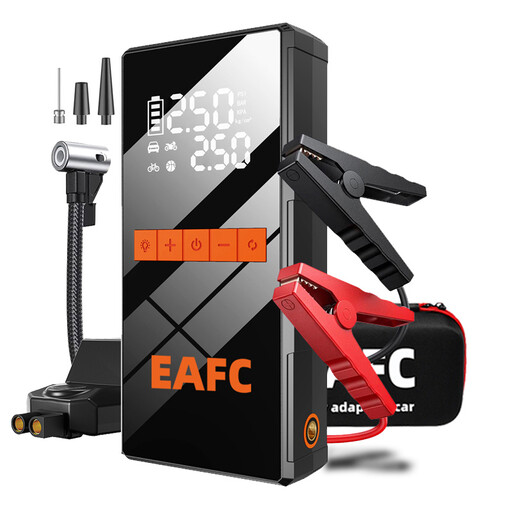
Why This Fits Their Persona: This is a practical, no-frills unit for drivers of typical family cars and hatchbacks. It provides peace of mind for the school run or daily commute without the cost of features you may not need.
It avoids the "peak amps" trap by clearly stating its suitability for smaller engines (up to 4.0L petrol/2.0L diesel), ensuring users buy a tool matched to their actual vehicle.
Its compact, 4-in-1 design is easy to store in a glove box. The 150 PSI compressor with auto shut-off is sufficient for standard car tyres.
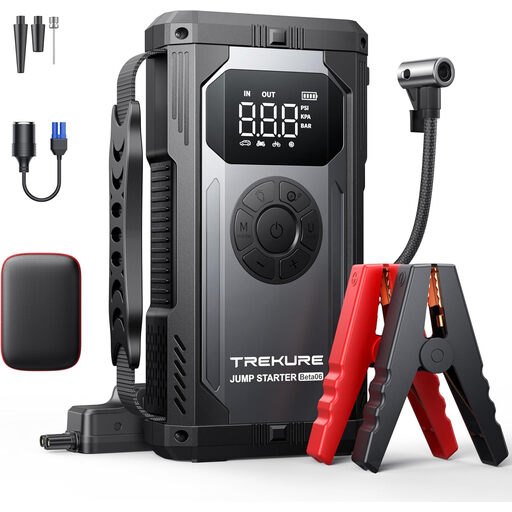
Why This Fits Their Persona: Ideal for owners of large SUVs, vans or those who take frequent road trips. This unit's high power and capacity provide the confidence to handle larger engines and multiple emergency situations.
It delivers genuine high-end power, supporting all petrol and up to 10.0L diesel engines. The fast 35 L/min inflation speed also counters the weak compressor pitfall effectively.
A substantial 5500A peak current and a large 23800mAh battery that doubles as a powerful multi-device charger. Includes a DC output for 12V car accessories.
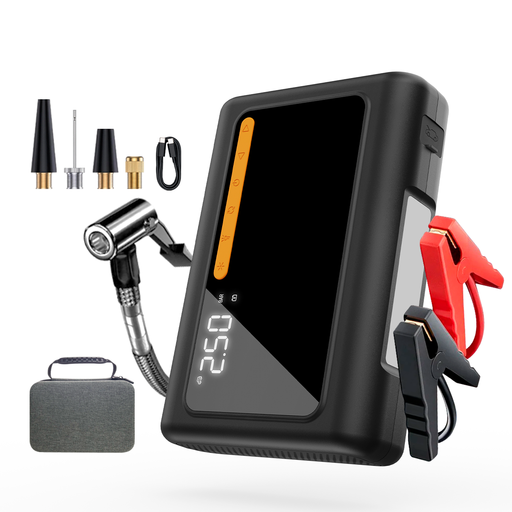
Why This Fits Their Persona: For the driver who prioritises long-term reliability and safety above all. This unit uses advanced battery technology for 'set-and-forget' peace of mind, performing reliably in extreme UK weather.
It directly solves the battery degradation pitfall. Its sodium-ion battery has an ultra-low self-discharge rate, allowing it to hold a charge for years, eliminating the need for frequent top-ups.
Exceptional battery stability in a wide temperature range (-40°C to 80°C), making it safe to store in a car year-round. It also boasts a much longer cycle life than lithium units.
We have compiled a complete, real-time list of products that fully satisfy these strict selection criteria and UK safety regulations.
How often do I need to recharge a car jump starter? This depends heavily on the battery technology. For standard lithium-ion models, it is good practice to check the charge and top it up every 3 to 6 months to ensure it's ready when you need it. For models with advanced low self-discharge batteries, like the sodium-ion unit mentioned, this interval can be much longer, often a year or more. Always refer to the manufacturer's guidance.
Can I leave a jump starter in my car all year round in the UK? Yes, but with caution. Most quality jump starters are designed to be stored in a vehicle and have an operating temperature range that covers typical UK weather, from freezing winter nights to hot summer days. However, extreme temperatures can affect battery performance and longevity. Look for models with a wide specified operating temperature range (e.g., -20°C to 60°C) for greater confidence.
What peak amp rating do I really need for my car? There is no single answer, as it depends on your engine.