
24/7 Customer Support

Free returns

Same-day & Next-day Delivery

Quality Guaranteed

Unlock Your Welcome Offers: FREE Delivery | Up to 80% OFF | Free 30-day JoyPlus trial
Download the APP
Choosing between lunch boxes and food storage containers can seem straightforward until a lid leaks in a work bag, a box proves too small for a child’s appetite or several pieces take over the kitchen cupboard. For UK households, the right choice depends on how food will be packed, carried, stored and cleaned.
This guide covers the common buying traps, the specifications worth checking and a selection of practical options for different routines.
A latch may keep a lid attached, but it does not automatically make a container suitable for soup, sauces or yoghurt. Leak resistance depends on the lid design, the seal and how evenly the lid closes. Product titles may use terms such as “leak-proof” or “airtight”, but check the full description and care instructions before carrying liquids in a handbag, schoolbag or laptop rucksack.
For extra protection, place liquid foods upright inside a separate lunch bag and avoid overfilling.
Large lunch boxes and food thermos jars can hold substantial portions, but capacity also affects weight and storage space. A container designed for family leftovers may be inconvenient for a primary school pupil or a commuter using public transport.
Think about the actual meal first. A divided lunch box may suit sandwiches, fruit and snacks, while a single-compartment stainless steel lunch box may be more practical for pasta, salad or a full meal.
Stainless steel containers should not be placed in a microwave, and some lids contain seals or plastic components that require hand washing. “Dishwasher-safe” may apply to the container but not necessarily every lid or accessory.
Always check the individual product instructions. A container that is simple to clean is more likely to be used regularly, but convenience should not override the stated care guidance.
Capacity is usually shown in millilitres or litres. For reference:
A divided lunch box can separate foods without additional bags, but fixed compartments may limit the size of sandwiches or larger portions. Removable or adjustable sections offer more flexibility where available.
Common materials include plastic, 304 stainless steel and 316 stainless steel. Stainless steel is reusable, resistant to many everyday stains and does not retain food odours in the same way as some softer materials. However, it is not microwave-safe and may be heavier than plastic.
For any lunch box or food container, look for clear information about:
Product descriptions should be treated as the starting point for checking suitability rather than a substitute for following the supplied instructions.
A single-latch lunch box can be quick to open, while a double-latch bento lunch box may provide additional points of closure. Neither style should be judged by the number of clips alone. Inspect whether the lid has a removable silicone seal, whether the seal can be cleaned thoroughly and whether replacement parts are available.
For airtight food storage containers, press the lid evenly around the edges. For a food thermos, pre-heating the jar with hot water or pre-chilling it with cold water can support the stated thermal-retention design. Do not use a container beyond its temperature or appliance instructions.
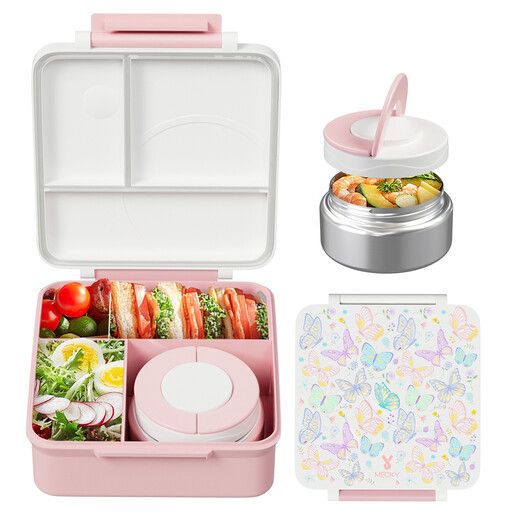
Why This Fits Their Persona: The 54oz divided format is a straightforward option for school lunches, office meals and snacks when separate sections are useful.
Its listed divided design helps reduce the need for several small snack boxes, while the single latch keeps the opening routine simple.
54oz capacity; divided layout; single-latch closure.
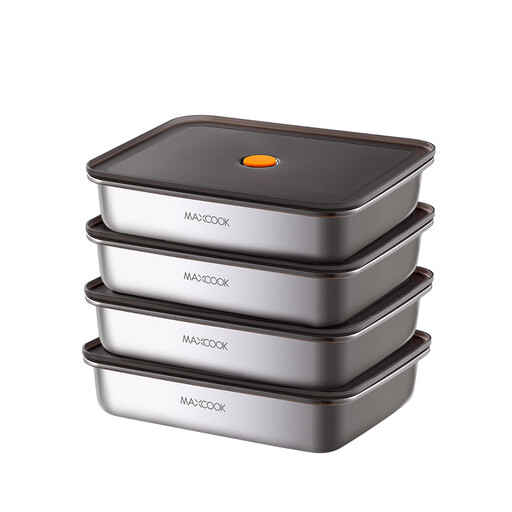
Why This Fits Their Persona: A four-piece set suits shoppers who want reusable food containers for lunches, leftovers, fridge organisation and freezer storage.
The listing identifies 316L stainless steel, secure-fitting lids and freezer and dishwasher suitability, giving buyers specific details to check rather than relying on vague durability wording.
Four containers; 316L stainless steel; listed as dishwasher- and freezer-safe.

Why This Fits Their Persona: Its wide-mouth, vacuum-insulated format is suited to commuters, campers and workers carrying soup, stew or other hot meals.
The wide mouth makes filling and cleaning more accessible, while the listing specifies a tight-sealing lid and advises keeping the jar upright.
1.4L capacity; 304 stainless steel; vacuum insulation; wide mouth.

Why This Fits Their Persona: Three capacities support snacks, individual portions and larger batch-cooked meals without requiring one oversized box for every task.
The stated capacities make portion planning clearer, and the listing includes specific warnings not to use the containers in a microwave or oven.
Three sizes; 316 stainless steel; listed dishwasher- and freezer-safe; suitable for meal preparation.
We have compiled a complete, real-time list of products that fully satisfy these strict selection criteria and UK safety regulations.
Yes, they can be suitable for sandwiches, fruit, snacks and prepared meals, provided the size and closure match the child’s needs. They are not suitable for microwave heating, so food must be heated separately before packing.
The stated retention period varies by product and conditions. The Maxcook food jar listings specify approximately 4–6 hours of thermal retention. Pre-heating the jar, filling it appropriately and keeping the lid closed can help it perform as described, but it should not be treated as a substitute for safe food-handling practices.
A set with different capacities is generally more adaptable than several identical boxes. Smaller containers can hold snacks or sides, while larger options can store batch-cooked portions. Check whether the products are listed as freezer-safe and dishwasher-safe, and confirm that the lids are suitable for the same use.