
24/7 Customer Support

Free returns

Same-day & Next-day Delivery

Quality Guaranteed

Unlock Your Welcome Offers: FREE Delivery | Up to 80% OFF | Free 30-day JoyPlus trial
Download the APP
Replacing a dim halogen with T10 W5W 194 LED bulbs can refresh your car’s interior, number plate or parking lights. However, matching the bulb code alone does not guarantee a suitable purchase. Socket depth, voltage, light colour and the vehicle’s bulb-monitoring system can all affect compatibility.
This guide explains the key checks for choosing 168 LED bulb, 501 LED bulb and 2825 LED bulb replacements without paying for features that do not suit your vehicle.
T10, W5W, 194, 168, 501 and 2825 are commonly used cross-reference numbers, but vehicle housings can still vary. A replacement may have the correct base yet be too long, too wide or poorly aligned inside a narrow lens.
Before ordering, compare the original bulb with the listed dimensions. The KATUR 24-SMD option, for example, is listed at 26.1mm long and 11.4mm wide. Also check your owner’s manual or remove the original bulb and compare it directly.
CANbus error-free LED bulbs include circuitry designed to reduce dashboard warnings or flickering caused by a vehicle detecting lower LED power consumption. This can be useful in newer cars, but compatibility is not identical across every model.
A bulb described as CANbus-compatible may still produce an error, faint glow or rapid flashing in some vehicles. Check the return terms and test the bulb before refitting trim panels. For exterior lighting, confirm that the colour and position are appropriate for your vehicle and comply with UK road-use requirements.
A very bright bulb can create glare in a reflective interior fitting, while blue or red bulbs may be unsuitable for some exterior positions. Blue LED bulbs are generally more appropriate for decorative or private-use applications rather than primary road lighting. White bulbs are commonly selected for number plate and interior lighting, while amber yellow and red options may suit particular marker or decorative applications.
Do not assume that a higher lumen figure automatically means better visibility. Beam direction, diffuser design and the position of the LEDs inside the housing also affect the result.
Look for compatibility with the exact code shown in your vehicle documentation or on the original bulb. Common equivalents include:
A plug-and-play car bulb should fit the existing wedge socket without cutting wires or adding an adapter. Some LED bulbs are polarity-sensitive: if the bulb does not illuminate, switch it around in the holder.
Most passenger cars use a nominal 12V system, although the charging voltage is higher while the engine is running. Some products are listed for 12–24V car LED bulbs, making them suitable for a wider range of vehicles, including certain vans and commercial vehicles.
Check the product’s stated voltage before buying. For example, some listed bulbs operate at 12V, while others specify 12–24V and around 3W per bulb. Lower power consumption can reduce electrical load, but it may also trigger a bulb warning if the vehicle expects the higher draw of a halogen lamp.
SMD LED chips provide a compact way to distribute light around the bulb. Products in this range use 3014 chipsets, with listed configurations ranging from 18 to 30 chips per bulb. A 360-degree lighting angle can help illuminate a housing more evenly than a single forward-facing LED.
Aluminium bodies can help transfer heat away from the LED components. Listed lifespan figures of up to 60,000 hours are product specifications rather than a guarantee of service life in every car. Heat, vibration, moisture and frequent switching can all affect actual performance.
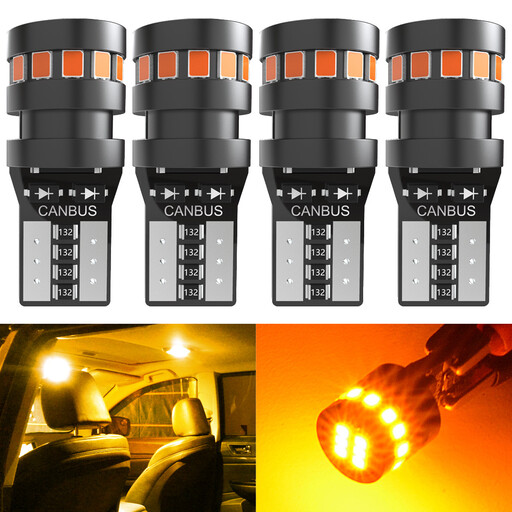
Why This Fits Their Persona: A practical four-pack for drivers replacing several interior, dome, map or number plate bulbs while keeping installation straightforward.
The listing states 12–24V operation and CANbus error-free design, while still advising buyers to check the original bulb and owner’s manual.
Amber yellow colour, 300 lumens per bulb, aluminium body and 18-2015 chipset configuration.
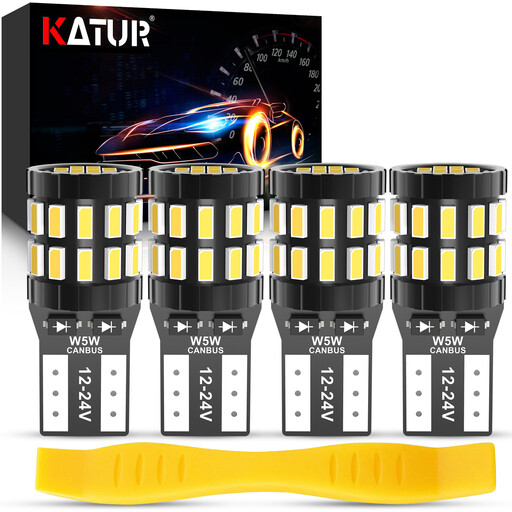
Why This Fits Their Persona: Suitable for owners seeking a cooler white appearance across interior, dome, map or licence plate fittings where that colour is appropriate.
Its specification identifies the supported bulb references, 12–24V range and plug-and-play fitting rather than relying on the T10 label alone.
6500K white light, 450 lumens, 30 3014 SMD chips and a 6063 aluminium body.
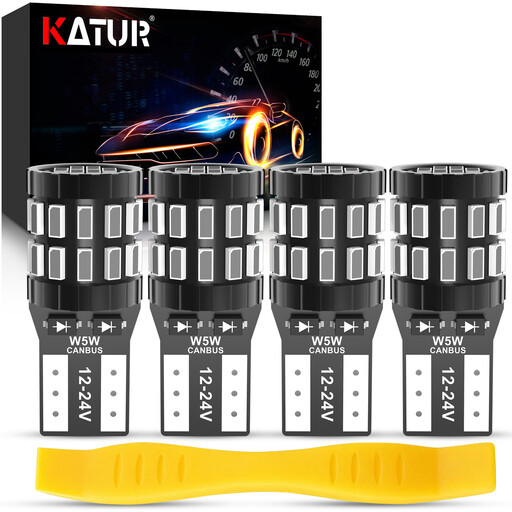
Why This Fits Their Persona: A choice for decorative interior projects or suitable private-use applications where blue light is permitted and desired.
The listing clearly states that blue light is for decorative purposes and should not be used for main lighting functions such as headlamps.
12–24V operation, 450 lumens, 30 3014 LED chips and a plug-and-play installation design.
We have compiled a complete, real-time list of products that fully satisfy these strict selection criteria and UK safety regulations.
They are often cross-reference numbers for similar wedge-style bulbs, but they are not a guarantee of fitment. Confirm the socket, dimensions, voltage and intended position in your specific vehicle.
No. They are designed to reduce compatibility problems, but vehicle monitoring systems differ. A warning, flicker or faint glow can still occur, so test the bulb before completing installation.
LED replacements commonly use less power than equivalent halogen bulbs. Actual consumption depends on the product specification and how long the lights are used. Check the stated wattage rather than relying only on general energy-saving claims.