
24/7 Customer Support

Free returns

Same-day & Next-day Delivery

Quality Guaranteed

Unlock Your Welcome Offers: FREE Delivery | Up to 80% OFF | Free 30-day JoyPlus trial
Download the APP
As an electric vehicle owner in the UK, you know that convenient charging is key. While the standard cable that comes with your car is often adequate, it rarely offers the flexibility needed for real-world situations. A kerbside parking spot just out of reach, a public charger blocked by another vehicle, or a home charge point installed on the wrong wall—these are common frustrations. This is where a 10m electric car charger lead becomes an essential accessory.
However, the market is filled with options, and making the wrong choice can lead to more than just inconvenience; it can be a costly and unsafe mistake. Before you buy, let's look at the common pitfalls to avoid.
To ensure you get a safe, reliable and efficient replacement EV cable, focus on these core parameters. Understanding them will help you select the right product for your specific needs.
This is the most critical factor for charging speed. In the UK, most home charging points operate on a single phase EV charger supply.
Action: Check your vehicle's manual or specifications for its maximum AC charging rate. Matching your cable to this figure is key to optimising charging times.
For public AC charging in the UK and Europe, you will almost always need a Mode 3 charging cable. This type of cable facilitates communication between the charging station and the vehicle for a safe and controlled charging session. The connector standard for modern EVs is the Type 2 to Type 2 cable. One end plugs into the charge point, and the other plugs into your car. This has become the near-universal EV charging cable standard, used by brands like Tesla, VW, Audi, Hyundai and many more.
A long EV charging cable is an investment that should last. Look for these indicators of quality:
We have selected a few options that meet these strict criteria, matching them to specific driver profiles to help you find the right fit.
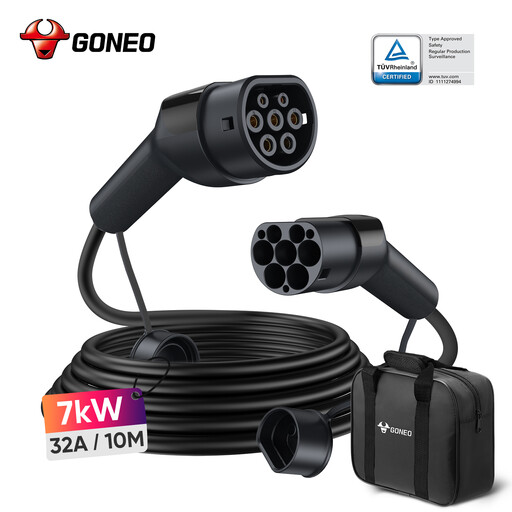
Why This Fits Their Persona: Ideal for owners of EVs or PHEVs with a standard 7.4kW on-board charger. The 10-metre length is perfect for overcoming inconveniently placed home or public charge points, ensuring you can always connect.
This is a fully certified 7.2kW EV charging cable with T?V, CE and UKCA markings. Its IP54 rating ensures reliable operation in wet weather, avoiding the fair-weather failure pitfall.
Perfectly matches the most common UK home charging setup for optimal speed. The durable TPU cable and robust connectors are built for long-term, frequent use.
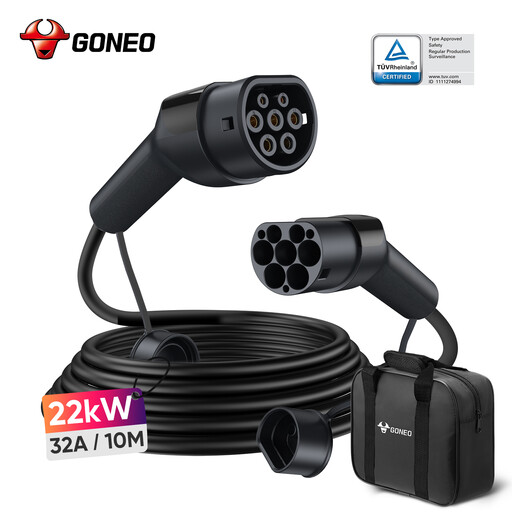
Why This Fits Their Persona: For drivers with high-end EVs that have a 22kW on-board charger and access to 3-phase power at home or work. This cable unlocks the fastest possible AC charging speeds.
It avoids the power bottleneck trap by providing the full 22kW (32A, 3-Phase) capability, ensuring your high-performance vehicle is never held back by its charging cable.
Enables maximum AC charging rates for compatible vehicles, drastically reducing charging time. The 10m length provides ultimate flexibility in any charging scenario.

Why This Fits Their Persona: This is the perfect match for the large number of BEVs with an 11kW on-board charger (e.g., Tesla Model 3/Y, Polestar 2). It offers a significant speed increase over single-phase charging.
It prevents you from overspending on a 22kW cable your car can't use, or underspending on a 7kW cable that would throttle your charging speed at a 3-phase point.
Precisely matched for 11kW charging systems, providing the ideal balance of cost and performance. The 10m length adds valuable convenience for any parking situation.
We have compiled a complete, real-time list of products that fully satisfy these strict selection criteria and UK safety regulations.
For a well-constructed, certified cable, the power loss over an additional 5 metres is technically present but practically negligible. You are unlikely to notice any difference in charging time. The immense convenience and flexibility offered by a long EV charging cable far outweigh any minimal, theoretical drop in efficiency.
Yes, provided it has an adequate weather-resistance rating. A cable with an IP54 rating or higher is designed for this purpose. The Type 2 connector system creates a sealed, weatherproof connection when properly plugged into both the vehicle and the charging station. However, it is always good practice to use the protective dust caps on the connectors when the cable is not in use to keep them clean and dry.
First, check your vehicle's specifications for its maximum AC charging capability (e.g., 7.4kW, 11kW or 22kW). Second, consider your primary charging locations. Most homes in the UK have a single-phase electricity supply, which limits charging to around 7.4kW, so a single-phase cable is sufficient. If your home or workplace has a 3-phase supply and your car can accept a faster charge, a 3-phase cable (11kW or 22kW) will allow you to charge much more quickly.