
24/7 Customer Support

Free returns

Same-day & Next-day Delivery

Quality Guaranteed

Unlock Your Welcome Offers: FREE Delivery | Up to 80% OFF | Free 30-day JoyPlus trial
Download the APP
Upgrading your car's lighting from the dim, yellowish glow of old halogen bulbs to crisp, modern LEDs seems like a simple task. However, the market for W5W CAN bus LED bulbs is filled with pitfalls that can lead to wasted money, frustrating dashboard errors and bulbs that fail within weeks. As a Joybuy Product Recommendation Officer, my role is to help you navigate past the marketing hype and select a product that performs as it should.
Before you buy, be aware of these common traps:
To ensure you get a reliable and effective upgrade, focus on these three non-negotiable specifications.
Your vehicle's CAN bus (Controller Area Network) is its central nervous system, monitoring all electronic functions, including the lights. A proper error free T10 bulb must have an integrated intelligent IC (Integrated Circuit) driver or a built-in load resistor. This component's job is to communicate effectively with your car's computer, mimicking the power draw of a traditional bulb to prevent false error warnings. When shopping, look for product descriptions that specifically mention an aluminium body for heat dissipation and an intelligent IC driver, as these are indicators of a more robust design.
You will see the codes T10 LED bulb, W5W LED bulb and 501 LED bulb used frequently, often interchangeably. For most practical purposes, these all refer to the same small, wedge-base bulb used across a huge range of vehicles. They are the standard choice for:
Always double-check your vehicle's owner's manual to confirm the fitment code, but if it calls for one of these three, they are generally cross-compatible.
The colour of a bulb is measured in Kelvin (K). Traditional halogen bulbs have a warm, yellowish tint of around 3000K. For a modern, premium look, a xenon white car bulb with a colour temperature between 6000K and 6500K provides a crisp, pure white light.
Equally important is the light distribution. Look for bulbs that feature multiple LED chipsets arranged around the body, not just on the tip. This design provides the 360-degree illumination necessary to light up the entire reflector housing, ensuring a full, even spread of light without distracting hot spots.
Instead of providing a generic list, we have matched specific bulbs to different types of UK drivers and their needs.
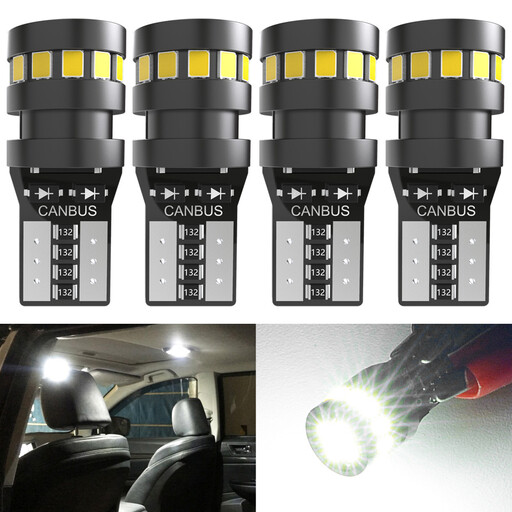
Why This Fits Their Persona: This driver wants a premium, crisp white light to match the factory LEDs on their modern car. Reliability and a clean, error-free look are paramount.
Its full aluminium body directly addresses the heat dissipation pitfall for better longevity. The design incorporates an intelligent IC and is promoted as having high vehicle compatibility, tackling the "error-free" myth head-on.
The 6500K xenon white colour provides a sharp, high-end aesthetic. The 360-degree lighting from 18 chipsets ensures even illumination, avoiding hot spots.
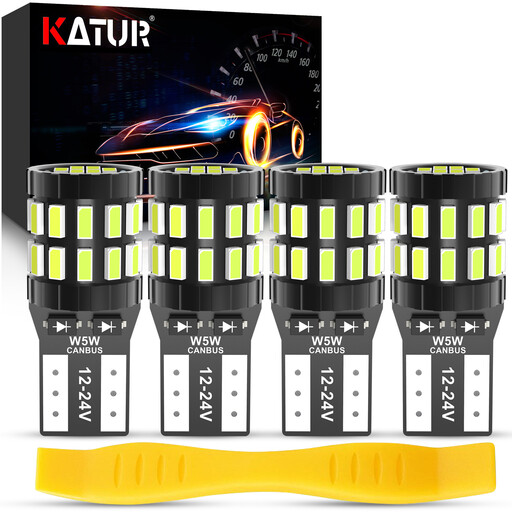
Why This Fits Their Persona: This user wants to add a unique touch to their car's interior lighting. They are looking for a specific colour to create a certain mood or theme, without sacrificing modern functionality.
It combines a custom colour with CAN bus compatibility, ensuring it works on modern cars without errors. The use of 30 individual LED chipsets provides bright, 360-degree light, avoiding the dimness or hot spots of cheaper coloured bulbs.
Offers a distinctive ice blue colour for interior customisation. The aviation-grade aluminium body aids heat dissipation for improved reliability.
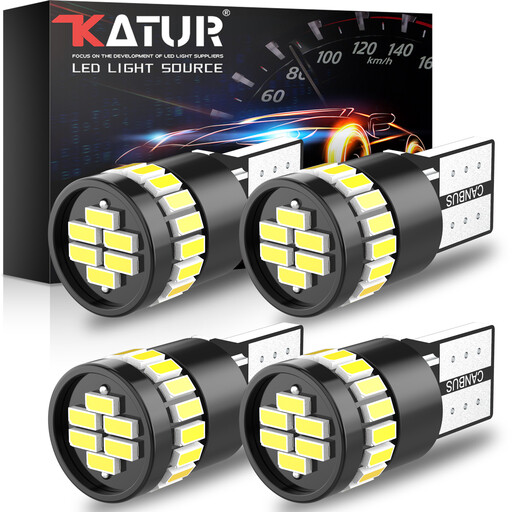
Why This Fits Their Persona: This driver needs a straightforward, functional upgrade from halogen. They want a clean white light and error-free performance without paying for the most premium features.
It is explicitly marketed as "Canbus error free" and features a 24-SMD chipset design. This multi-chip layout provides the 360-degree light spread needed to avoid the "hot spot" pitfall common in affordable bulbs.
A cost-effective and simple plug-and-play upgrade to modern 6000K white light. The 1:1 sizing compared to the original bulb ensures an easy fit into the housing.
The W5W/T10/501 fitment is one of the most common for small automotive bulbs. However, car manufacturers occasionally use different bulbs even within the same model year. The most reliable way to ensure compatibility is to check your vehicle's owner's manual or remove the existing bulb to read the code printed on its base before you order.
While high-quality CAN bus bulbs work flawlessly on the vast majority of vehicles, some cars, particularly certain models from German manufacturers like Audi, BMW and Mercedes-Benz, have exceptionally sensitive monitoring systems. In these rare cases, the system may still detect the slight difference in power consumption and trigger an error. If this happens, an additional load resistor may need to be wired in parallel with the bulb to resolve the warning.
No. UK law is very clear: the light illuminating your rear licence plate must be white to ensure it is clearly visible. Using coloured bulbs (such as blue, red or yellow) for your licence plate is illegal and can result in a fine and an MOT failure. Coloured bulbs should only be used for interior applications like car interior LED lights (e.g., map, door or car dome light replacement) or for off-road use.